

Tell me if this sounds familiar.
You want to be an excellent pilot.
Like really bad.
You’re tired of bombing out when you know you can do better, or how your mind races when others watch you on launch, or how you feel nervous of collapses in rough air even though you’ve done some SIV.
This gives you a boost of motivation to do some ground handling.
But you get bored. You Don’t really see the point and a fews weeks later, nothing has changed.
You don’t even know what’s happening. You still fall out the thermal and end up on the ground while others are staying up.
It sucks.
It’s like you never even tried to change.
Because, well, you didn’t.
You didn’t actually try. You dabbled. You treated ground handling like an I should not an I want to.
I’m not going to tell you what to do. This is your journey and you can approach paragliding how you want.
However, if you want to become an excellent XC pilot, I’d like to offer you a perspective (as a full time instructor, guide, coach, and an active XC pilot) that I’m willing to put money on will change the way you view ground handling.
Buckle up.
It’s time to climb.
The Mindset
“Great pilots are made on the ground.” ~ said every instructor ever
You are a warrior.
XC paragliding is the arena.
This might sound a little strange at first, especially if you’ve never thought about this way, but it’s the difference between pilots that get great at XC vs everyone else.
A warrior approaches the craft with sincerity.
A warrior aprpoaches the craft with respect.
A warrior trains the fudamentals so well they become as natural and automatic as walking.
Imagine two Samurai.
One uses his sword occasionaly to show friends but seldom practices. The other practices daily. He’s mastered sheathing his sword. He’s intimately familiar with it’s weight and balance, and practices striking and defence until his actions are spontaneous and flowy.
Now if these two were to enter into combat with eachother which one would you want to be? Which one of these would you consider a warrior?
The second one, of course.
The difference between them isn’t talent. It isn’t equipment, wealth, upbringing, circumstances or any other external factor that would make a nice sounding excuse.
The difference is mindset.
Great pilots know their wing as intimately as a Samurai knows their sword.
They’ve spent years mastering the fundamentals knowing full well that this ground work is the only way to prepare for the realness of the air.
They recognise there are real stakes at play.
That sh*t can, and does, go wrong.
So they approach XC with sincerity and respect.
Shouldn’t you do whatever it takes to master the balance, timing, and feel of your wing?
The Mistake
Practice makes perfect.“…only perfect prctice makes perfect.” ~ Vince Lombardi
But here’s what most pilots get wrong.
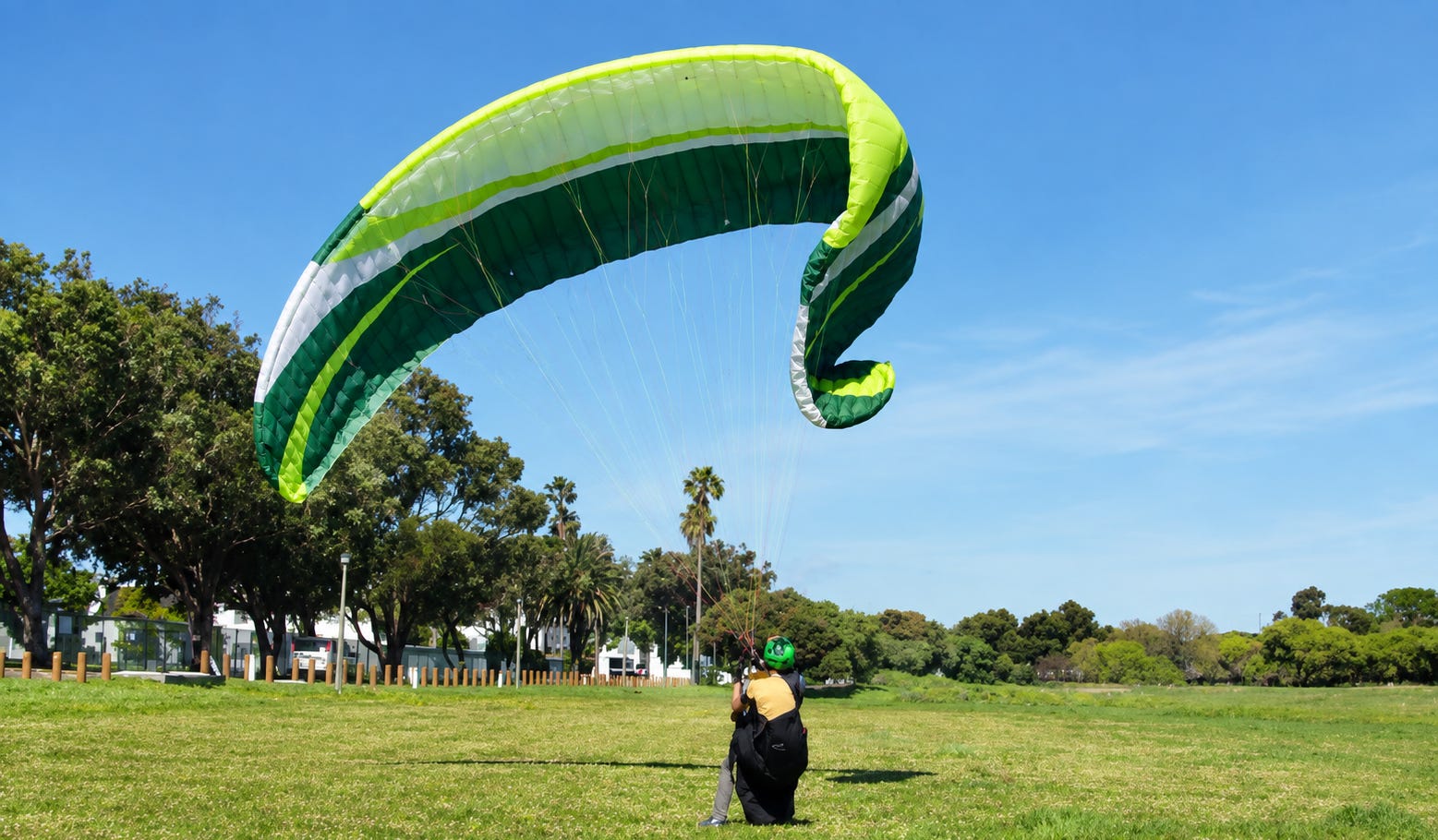
Inspired, you go out on a nice open grassy field.
You spend an hour keeping your glider above your head in laminar wind.
Job done.
But in the coming weeks and months this does nothing for your XC flying. You go out a few more times but then you get bored and you stop.
But this is because you are training the wrong way.
By now you’ve probably heard the legendary stories of Chrigel Maurer who used to ground handle in 40+ kph winds, in snow fields, to challenge himself, expand his skills and learn what’s possible.
Like our well-prepared Samurai, Chrigel knows that the more difficult the practice conditions are, the easier and more intuitive paragliding becomes in the wild.
In fact, Chrigel says that paragliding is 90% feeling which can be trained.
But only by putting in the right kind of reps.
If there’s anything you take away from today let it be this: If you’re going to fly in turbulent (ie thermic) conditions, then you must train your skills in turbulent air.
But don’t go blindly jumping into the deep end. Chrigel didn’t start in 40+ kph winds - that would be madness.
The key is to challenge and stretch yourself little by little.
In flow science, this zone of optimal performance emerges when your skills are pushed to their edge. It’s that razor-thin margin where the task is just difficult enough to demand 100% of your attention, but not so hard that you freeze up.
As you do this your mind and body will adapt, and the connection with your glider will strengthen as you experience the blisfull and thoughtless state of flow more often.
The problem is that most people don’t do this.
They’re imprisoned by the myth of talent; if something doesn’t come easily or quickly they subconsciously create self-fulfilling excuses because, “I don’t have it”, which stops them from doing the practice that would actually build the skill.
The feeling you need to be an excellent XC pilot isn’t a gift, it’s earned through the right kind of practice.
The Benefits
“You should be far more concerned with your current trajectory than with your current results.” ~ James Clear
Your paragliding ability is a direct result of the time and energy you’ve put in.
That means if you want to get better, if you’re not happy where you are, if you’re frustrated or nervous then chances are your groundhandling needs work.
But why groundhandling, surely hours in the air are more important?
Well, yes, and no, maybe sometimes.
There are two main reasons why you might resist ground handling.
Because it’s boring
Because you don’t really see the benefits to XC flying
The Solution to Boring
The first one is an easier fix than you might think.
Make it challenging. Make it palyful. Do it with friends.
When I was starting out my friends and I would have little wars with eachother. Kiting into eachother’s gliders to block the airflow and try to knock the other wings out the sky.
We would set little obstacle courses like jumping onto park benches and challenge eachother to keep the wing up the longest.
Over time, this practice extended to stronger and more turbulent conditions until we were all confident to pull up our wings in conditions many pilots would call crazy.
And while you may not have other pilots to practice with, sharing your progress with other like-minded pilots can have the same effect.
Like Jason, a Wingmates member, who lost his flying confidence, almost quit, and then regained his mojo after sharing and working through his experience with the community.
He faced his fears, got the support he needed, put in the work, and is now happily flying again.
How Ground Handling Improves XC
Now if you’re still not convinced that ground handling is the key to get great at XC then this last point is for you.
Early in my paragliding career I struggled to get going.
I made up lots of excuses not to go flying when in reality I was avoiding the takeoff. When I did go flying my nerves would spike on the way up to launch and I’d struggle to stay up, bombing out and getting frustrated while others were flying.
One day I listened to Chrigel describing his ground training ethic on a podcast and something clicked. I decided to approach my ground handling as the most important part of my training.
Slowly but surely my takeoffs got better. My thermaling improved and my collapse prevention (active flying) got better.
I had fine-tuned my feel of the glider, I entered flow state and flew my first 50km with no vario.
Why, because all that time on the ground building up to those difficult conditions is what allowed me to develop the hidden grail that Chrigel talks about - feeling and intuition.
Now I’m by no means implying that I’m on a level anywhere near that of Chrigel. I haven’t worked nearly as hard as he has. But his work ethic inspired me to shift my own practice which enabled me to achieve a level of piloting skill that saw me set multiple local XC records, some while still flying my EN B.
I don’t say this to brag. I hope to inspire and encourage.
I believe that with the right minsdet and the right practice becoming an excellent pilot is within your reach.
But here’s the most overlooked benefit of all of this.
The reward, the joy, and the satisfaction didn’t come from the numbers or the records. It came from the growth I experienced as my confidence grew.
I was in control. My glider and I were one.
Each new challenge I overcame, each new PB I flew, each new fear I faced became a outward proxy for the inner growth I was, and still am, experiencing.
The magic of mastering your wing on the ground is that it directly benefits all aspects of your XC flying, both mental and physical.
The more in tune with your wing, the more flowy and spontaneous your actions become, which leads to more joy, more confidence, and better results.
As any good instructor will tell you.
“Great pilots are made on the ground.”
When last did you go ground handling?
I ALWAYS fly better if I've kited recently, last time I kited it was at 5pm here in tx ...it was about 107F/41C here lol. toasty and spicey! (picked an area by a like to avoid dust devils)