

In a recent online workshop inside Wingmates, Nick highlighted a common problem faced by paraglider pilots around the world.
“I start feeling like I’m not sure if I’ll be able to think fast enough to do the right thing. So I stopped watching them (crash videos) because I think this is where a lot of my fear is coming from.”
And he’s right. He can’t think fast enough. Nobody can. In fact, pilots who excel and fly with confidence aren’t thinking faster - they’re thinking less (more on this later).
Jason, also in Wingmates, had this to say:
Even if you have no doubts in your ability to handle these dynamic situations correctly, there are several neuropsychological processes impacted by these worst-case-scenarios that may cause the silent deterioration of your confidence in flight.
I’m sure you’ve felt this intuitively, or even thought about it, but let me share some discoveries that crystalised it for me.
To do this we’ll first dive into a little neuroscience and psychology before I offer an approach (used even by fighter pilots) that I believe, if adopted, will lead to a community of happier and more confident pilots.
Sharks, Spiders, and Stable Hallucinations
In 1975 Jaws fundamentally shifted the public perception of sharks from obscure marine animals to ruthless, man-eating predators, creating lasting galeophobia (fear of sharks) with real-world consequences. Global shark populations dropped 70% over the following 50 years, and Spielberg himself believed Jaws played a meaningful role in eroding public will to protect them.
In 1990 the release of Arachnophobia amplified and validated spider fears, while making many viewers afraid of spiders who had not previously considered themselves phobic.
Neither of these movies were real yet the brain treated them as reality, significantly altering the lives of many people that watched them. Why?
Under the predictive processing (PP) framework we see that the brain is not a passive receiver of information like a camera but more like a projector. Using the same cognitive structures that generate dreams, it creates a model of reality based on priors — experiences and expectations — and then updates its predictions with incoming sensory data when discrepancies lead to prediction errors.
When you watch Jaws, the brain isn’t passively receiving entertainment — it’s actively generating and updating its model of what the ocean contains.
This means the boundary between perception and imagination is not always sharp, or as neuroscientist Anil Seth puts it, “Your brain hallucinates your conscious reality.” This is why fictional experiences can become genuine priors for our predictive brains.
One of the major functions of the brain and learning is to reduce uncertainties about the environment and allow you to better predict what will happen next. When these predictions are difficult to make, we experience the situation as unnerving.
So a shark (spider, snake etc.) movie doesn't just scare you once — it installs a prior that makes the ocean perpetually harder to predict safely, which itself generates ongoing anxiety.
By now you can see where I’m going with this but may ask; wouldn’t a paragliding crash video watched analytically — “what went wrong, what should they have done?” — update useful priors?
The bad news is no, the “analytical watching” justification doesn’t hold up as well as pilots may assume.
“Analytical Viewing” is Self-Deception
Who experiences more trauma, survivors of an event or those exposed to media covering the event?
Researchers have found data supporting that people are vicariously traumatized when viewing media pertaining to traumatic events. One striking study found that people who watched six or more hours of media per day in the week after the Boston bombings had higher stress levels than people who were directly exposed to the bombing.
The media exposure was more distressing than being physically present — because the brain kept re-running those priors.
This vicarious trauma is real and measurable and shows up across studies. In aviation, hearing about a crash, especially on a familiar route, can stir creeping fear and a host of other sleep and anxiety problems.
“It could have been me”
This vicarious exposure elicits stronger responses when people feel psychologically connected to the victims — the “it could have been me” effect.
This is exactly what happens when you watch paragliding crashes or traumatic collapses. The identification with the pilot is real. You recognise yourself in them. It’s not abstract.
And to make it worse the “why” behind the collapse is often unclear because the air is invisible turning the sky, like a “shark-infested” ocean, into an unwelcoming place filled with danger. The brain doesn’t just remember the video, it incorporates it into the generative model it uses to simulate flying in real time.
In other words, watching enough crashes doesn't just teach "crashes are dangerous" — it starts to make ordinary flying feel more threatening. The analytical intent of the viewer doesn't override this automatic conditioning process, it leads to something far more debilitating — fear generalisation.
The Birth of Fear
Observational learning (indirect learning) is a powerful way of transmitting information between people and plays a fundamental role in how we learn about the world.
Watching others lets us learn about risk and rewards while dodging the dangers of direct experience (direct learning). We learn about intentions and motivations by monitoring and predicting the behaviours of others and pick up motor skills by modeling them.
This explains the appeal of these videos, they tap into our natural inclination to observe and learn what not to do from the experience of others. However, exposure to these indirect threats can lead to anxiety as the brain conditions and then generalises the fear response.
Fear conditioning happens when a neutral stimulus becomes associated with a threat through repeated pairing. In the classic laboratory model, a neutral image or tone is paired with an electric shock often enough that the neutral stimulus alone begins to trigger a fear response — the brain has learned to treat it as a reliable signal of danger. This is not a conscious decision. It is an automatic updating of the brain’s threat-detection system, occurring below the level of deliberate thought.
Fear generalisation is what happens next. Once a fear response is conditioned to a particular stimulus, the brain does not confine the response to the stimulus. It spreads the threat signal across to similar cues — a kind of safety-first overcorrection that makes evolutionary sense. Better to fear all snakes than to miss a genuine threat by being too precise. The brain loses its ability to confidently distinguish this is the threat from this is similar to the threat, and the fear response bleeds into a wide range of situations. You can probably see where this is heading for paragliding.
A 2023 study demonstrates that observational learning produces broader generalisation than direct learning. When fear is acquired by watching someone else experience a threat, rather than experiencing it directly, the brain’s ability to discriminate between threatening and safe stimuli is actually reduced. Observers showed flatter generalisation gradients and higher shock expectancy to stimuli that were merely similar to — but not — the conditioned threat. The brain, in effect, becomes less precise in its threat detection after vicarious fear learning than after direct experience.
When a pilot watches a collapse video, the brain is doing exactly what it evolved to do — learning about a threat from a safe distance. The wing, the conditions, the sounds and visuals of the moment of collapse all become loosely associated with danger.
But because this learning is observational, the generalisation is broader and less discriminating than if the pilot had experienced the event themselves. The brain does not cleanly encode “that specific combination of conditions caused that collapse.” It encodes something fuzzier and wider: flight involves this kind of threat.
The fear response then attaches to anything that resembles it — the sound of the wind on takeoff, the feeling of the wing in active air, the movement of the harness through turbulence.
The pilot is no longer just afraid of what caused the crash in the video. They are, to a measurable neurological degree, more afraid of flying in general. And because this process is unconscious and automatic, it bypasses the pilot’s rational confidence entirely. They may believe they are flying with the same composure as before, while their nervous system has quietly shifted its baseline threat assessment upward across a wide range of in-flight sensations.
The brain is a generative model that updates its priors based on exposure, and the content of what you feed it matters enormously — regardless of the narration layered on top. An instructor talking calmly over footage of a catastrophic collapse is still installing the visual prior of "wing above head → sudden violent deformation → pilot in trouble." The prefrontal cortex might be tracking the instructor's analysis, but the amygdala and the deeper threat-detection systems are encoding the raw sensory data.
This is the mechanism by which crash video culture unintentionally erodes confidence without pilots ever knowing it is happening.
The good news, there is a better way.
Train Paragliding Like a Top Gun
Fighter pilots don’t passively consume crash footage and hope it protects them. They do study accidents — but within a structured system where every hour of failure analysis is backed by many more hours of competence building.
The ratio matters. And much of paragliding culture has it inverted.
In military aviation, mishap review serves a purpose. But it is confined to formal debriefs led by instructors, focused on decision-making and environmental understanding — why the pilot chose to continue into deteriorating conditions, what the terrain was doing, where the chain of errors began.
Focused on decision making, it is analytical in the truest sense: stripped of spectacle, directed at extracting actionable lessons, and compartmentalised so it doesn’t bleed into the pilot’s mental state before the next flight.
But this is the smaller part of the system. The larger part — the part that actually builds confident, competent pilots — is rehearsal of what right looks like.
Chair Flying
Since at least World War II, military pilots have used a technique called “chair flying.” No engines, no fuel, no risk. Just the pilot building neural pathways for correct action.
A study at the United States Air Force Academy found that pilots who chair-flew showed faster mission completion, more precise takeoff speeds, and better situational awareness than those who didn’t.
Chair flying at the United States Air Force Academy is a foundational mental rehearsal technique used in airmanship programs, including soaring and powered flight, to practice procedures before live flights. It develops "airmindedness," helping cadets simulate checklists, maneuvers, and emergency procedures to build confidence and decision-making skills.
This isn’t passive visualisation. Pilots move their hands to imaginary switches, verbalise radio calls out loud, and walk through emergency procedures step by step. Three-time world aerobatic champion Klaus Schrodt told Plane and Pilot magazine: the entire flight has to be imagined, seen, felt, smelled, heard — and the actual flight needs to be a copy of the mental preparation.
The brain doesn’t distinguish sharply between vividly imagined action and real action. The same motor pathways activate. The same priors are installed. But instead of priors built from watching others fail, these are priors built from rehearsing your own competence.
The neuroscience validates this. Visual-motor behavioural rehearsal (VMBR) — the scientific framework behind chair flying — has been shown to improve performance across domains from tennis serves to dart throwing to free-throw shooting.
The mechanism is the same predictive processing model we discussed earlier, but working in the opposite direction: instead of the brain updating its generative model with threat priors from crash footage, it updates with competence priors from rehearsed successful action. The brain begins to predict success rather than catastrophe.
Paragliding has its own version of chair flying, and it’s one of the most undervalued tools in a pilot’s development: deliberate ground handling or what I call Chaos Training.
Hours spent on the ground with the wing — feeling the pressure through the lines, learning to anticipate the glider’s movements, building the muscle memory of brake inputs and weight shifts until wing control becomes automatic.
This is not a beginner exercise to graduate from. It is the paraglider pilot’s simulator. Every hour spent deliberately ground handling in varying wind conditions installs the same kind of competence priors that chair flying installs in a fighter pilot — the body learns what right feels like, so that in the air, correct responses happen before conscious thought has time to intervene.
And of course, we can do this in a chair too — visualising flight vividly, feeling the inputs, hearing the wing, building confidence before we ever leave the ground.
Bandura and the Architecture of Confidence
Fear in paragliding has two dimensions: the emotional anticipation of something going wrong, and the skill gap of not knowing how to respond if it does. Crash videos inflate the first while doing nothing for the second. Competence modelling and progressive flying address both simultaneously.
Psychologist Albert Bandura’s self-efficacy theory provides the framework for understanding why this works — and why crash videos don’t.
Bandura identified four sources of self-efficacy, the belief in one’s ability to handle a given situation. The most powerful is mastery experience — actually doing the thing successfully. Next is vicarious experience — watching others who are similar to you succeed or fail. Then verbal persuasion and physiological state.
Crash videos are negative vicarious experience. You watch someone like you — a paraglider pilot, in conditions you recognise, on equipment you fly — fail. Bandura’s research consistently showed that watching similar others fail lowers self-efficacy. The observer doesn’t just learn “that was dangerous.” They absorb, at a level beneath conscious reasoning, a diminished belief in their own capacity to handle similar situations.
This is precisely the problem Nick and Jason were describing at the start.
In a classic experiment, Bandura divided participants with snake phobias into two groups. One group directly handled snakes. The other merely observed someone else handling them. The direct experience group showed significantly higher self-efficacy and lower fear in subsequent encounters. The implication is clear: direct mastery experience is the most powerful confidence builder, and observation — while useful — is a weaker and more fragile source of belief in one’s own competence.
This maps directly onto paragliding. A pilot who has spent hundreds of hours ground handling in strong, gusty wind — feeling the wing load and unload, catching asymmetric collapses through the risers before they develop, instinctively keeping the glider open overhead — has a qualitatively different relationship with turbulence than a pilot who has watched a hundred collapse videos.
The first pilot’s nervous system has encoded “I know how this wing behaves and I know how to keep it flying.” The second pilot’s nervous system has encoded “this is what it looks like when things go wrong.”
One pilot has built competence. The other has accumulated dread.
The Coping Model — What You Should Actually Be Watching
If you are going to learn vicariously — and we are social creatures, so of course you will — the question becomes: what should you be watching?
Research in modelling therapy offers a clear answer. The most effective model for reducing fear and building competence is not a mastery model (someone who handles the situation effortlessly and fearlessly) and certainly not a failure model (someone who is overwhelmed). It is a coping model — someone who begins with visible apprehension, encounters the challenge, and gradually works through it with increasing competence.
This has been demonstrated clinically. Modelling films showing coping models — individuals who are initially fearful but progressively manage the feared situation — consistently outperform other approaches in reducing anxiety and building adaptive behaviour. The observer sees someone like them, recognises the fear, and then watches that fear be navigated successfully. The brain encodes: this is frightening, and it is manageable.
For paragliding, the coping model equivalent would be footage of a pilot entering strong thermic conditions, actively working the wing, managing the bumps and surges, and continuing to fly with growing composure. Or a cross-country flight where a pilot encounters rowdy air, keeps the wing open through active piloting, and progressively relaxes into the conditions. These videos install a fundamentally different prior than crash footage: the prior that says turbulence is something I can work through, not something that ends in disaster.
A great alternative if you can’t get hold of examples like this is to join a community of pilots (like Wingmates) and connect with pilots at a similar level and watch them over time overcome their own anxiety, while also being an inspiration for others.
A New Training Culture
The alternative to crash video culture isn’t ignorance of risk. It’s a deliberate rebalancing of what pilots feed their brains.
Watch competent pilots handle real conditions — thermal flying, active air, cross-wind launches, challenging landings. Then visualise yourself doing it. Walk through the sequence in your mind: the feel of the brakes, the weight shift, the visual picture, the sound of the vario. Build the priors for competent action rather than catastrophic failure.
Pursue direct mastery experiences progressively. Spend more hours ground handling deliberately — not just kiting casually, but practising specific skills in stronger conditions until they become automatic. Fly in slightly more challenging conditions with a mentor present. Build your envelope gradually through accumulated success, not through shock exposure. Each experience where you handle what the air gives you is Bandura’s mastery experience and aligns with the flow model, installed directly into the nervous system through lived action.
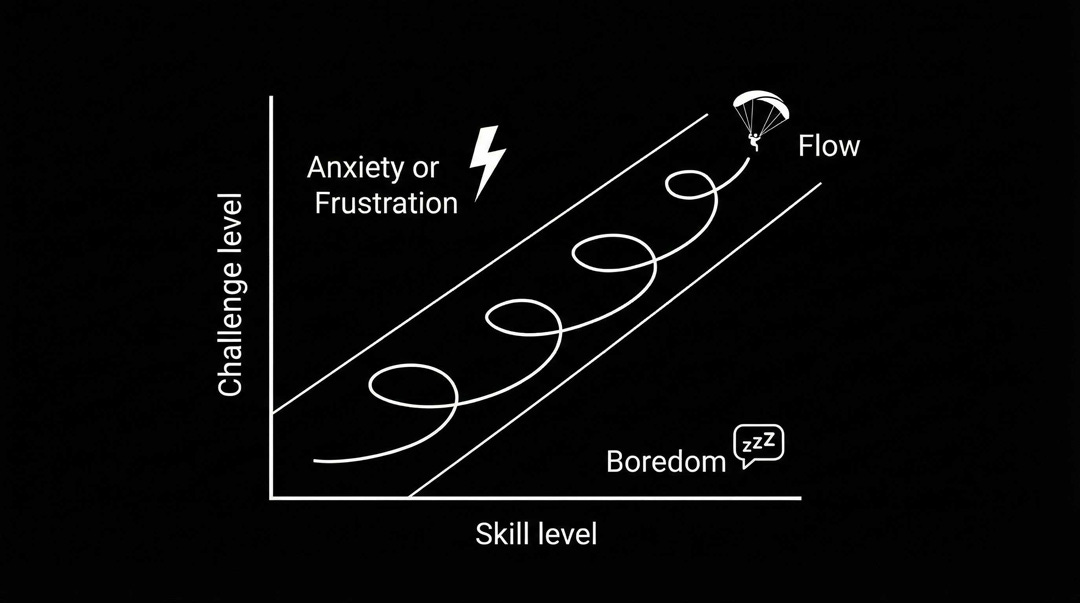
When you do engage with failure analysis — and there is a place for it — do it in a structured context. A debrief with an instructor, focused on decision-making and environmental reading, not raw footage consumed alone on a screen. And always ensure the ratio favours competence: for every minute spent understanding what went wrong, spend many more rehearsing what right looks like.
Fighter pilots don’t build confidence by cataloguing disasters. They build it by rehearsing competence until correct action becomes automatic — until the body knows what to do before the conscious mind has time to think. This is what Nick was intuiting at the beginning of this article when he said he couldn’t think fast enough. He’s right. The pilots who fly with confidence aren’t thinking faster. They’ve trained their responses so deeply that thinking isn’t required.
That’s not achieved by watching crashes. It’s achieved by practising mastery.
Bonus
If you’ve made it this far you must be serious about your own progression - in these days of content bombardment I want to focus on quality over quantity. Your attention means a lot to me.
I’m so passionate about your progress and wellbeing I’ve decided to further my education in both coaching and flow science, I’ve decided to become an ICF accredited Flow Coach through the Flow Centre—the world’s leaders in this field.
The training is seven months of deep, theoretical and practical work. This means if you join Wingmates you’ll be benefiting firsthand as I apply these frameworks directly within our community to help you perform better and fly safer.
Wingmates
We’re seeing amazing progress in our members and I want you to have that opportunity as well.
To make it easier to join this journey from the start, I’ve made two big changes:
Monthly Payment Option
Founding Member Rate: For a limited time, I’ve rolled the price back to our original rate (and you’ll keep this price for as long as you’re a member).
That means world class coaching, weekly live events, and a supportive global community, at a very low rate.
Spots at the founding member rate are limited, so if you are on the fence, now is your time.
[Grab the Founding Member rate here]
We’re building a global connection of pilots focused on the craft of flying—no ads, no algorithms, just flow.
Happy flying,
Grant
P.S. If you’re not fully satisfied within the first week, I offer a full money-back guarantee. No questions asked.