

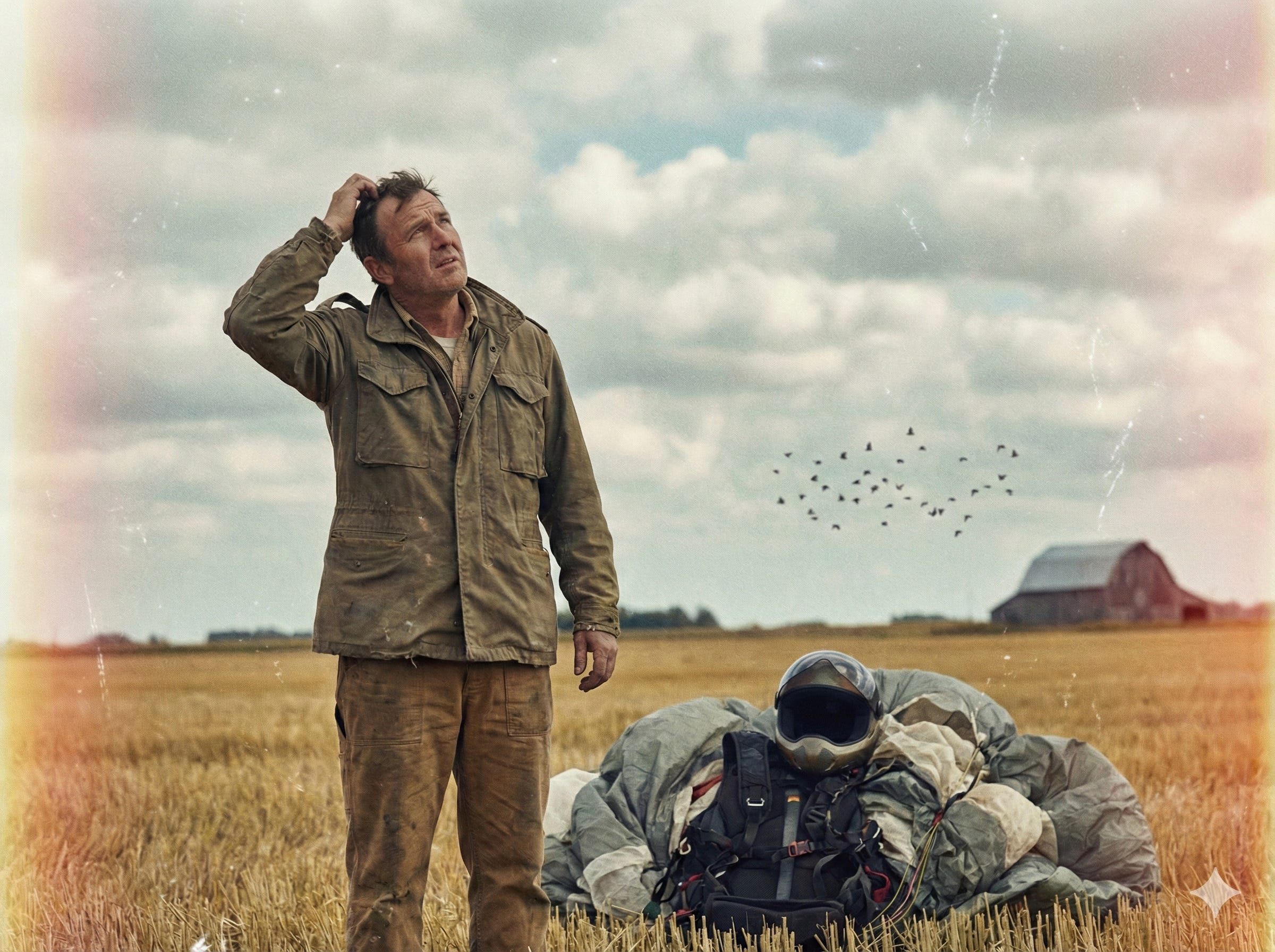
Have you ever landed after a great flight only to feel worse after discovering your wingmate flew further?
This undercurrent of comparison is common in paragliding and affects us all at some stage of the journey sometimes with devestating consequences.
If left unchecked this mind virus diminishes your ability to get into flow, lead to risky decisions, and rob you of the love you once had for this surreal thing we do.
Today, we’re diving into how these mental patterns hold you back and, more importantly, how to fly your own line, both in the air and in life.
How Comparison Steals Your Airtime (and Joy)
At its heart, paragliding is a mental dance deeply entrenched in the now – a conversation between you, your wing, and the elements around you.
Flow, that coveted state of complete absorption and effortless action, thrives in this present-moment awareness.
Comparison, however, yanks us right out of it.
When we constantly measure our progress, skills, or even our equipment against others, we shift our focus from our internal experience to external (and often arbitrary) benchmarks. This can:
Fuel Negative Self-Talk: Unfavourable comparisons are breeding grounds for thoughts like, “I’m not good enough,” “I’ll never fly 100km,” or “Everyone else seems to progress faster.” This inner critic erodes confidence and makes learning feel like a chore rather than an adventure.
Distort Reality: We often compare our “behind-the-scenes” struggles with someone else’s “highlight reel.” We don’t see their hours of practice, their own frustrations, or the unique conditions that might be favouring them at that moment.
Undermine Joy: Flying should be, at its core, joyful. Comparison sucks the joy out of personal achievements because there’s always someone “better” to measure against.
Block Flow: Crucially, flow follows focus. When your mind is occupied with judging yourself or others—an external focus—you cannot be fully present and immersed in your internal experience with the environment and your wing. This external distraction pulls you away from the sensory inputs and intuitive responses that cultivate a Flow state, which is the very essence of deeply engaged flight.
The truth is, we all have unique journeys with different starting points, learning curves, and even different definitions of what success means.
Factors like starting aptitude, mental conditioning, available flying time, local conditions, personal risk tolerance, finances, and past experiences all shape our individual paths.
Learning to remove judgement and embrace your stage of the journey is key.
When the Navigator Takes the Wheel
Finding Flow involves letting go and trusting your ‘Self 2’ – your intuitive, subconscious, being self – to do the ‘driving.’
Think of your thinking mind as the navigator: it can set the general direction or goal (e.g., “stay up,” “explore that cloud street”). But the actual nuanced art of flying, of feeling the air and responding instinctively, comes from allowing your well-trained, intuitive, being self to take the controls.
If the navigator (ego) is constantly grabbing the wheel out of fear or comparison, the journey becomes jerky, stressful, and inefficient.
Trusting your inner pilot to figure things out, based on your training and experience, is essential for a smooth, absorbed state of Flow.
“Failure”
Accepting your unique path radically changes how you view setbacks.
Instead of seeing a ‘bombed-out’ flight or a fumbled launch as a ‘failure,’ what if you reframed it as a valuable data point?
“In the growth mindset, failure can be a painful experience. But it doesn't define you. It's a problem to be faced, dealt with, and learned from.”
Carol Dweck
When things don’t go as planned, try meeting the moment with a curious “How interesting!” and look for the growth lesson.
This isn’t about dismissing frustration, but about shifting from harsh judgment to neutral observation.
Each perceived misstep provides rich information – data for you to learn from, refining your understanding and skills.
This approach echoes the Stoic idea of Amor Fati – a love of one’s fate, or trusting the process.
This philosophy encourages you to embrace all of it: the smooth soaring days and the challenging, frustrating ones, seeing them as integral and necessary parts of your unique journey.
Paragliding, like life, has its natural rhythms; there will be exhilarating highs and character-building lows. By learning to appreciate this entire spectrum of experience, seeing every flight not just as an isolated event but as a contributor to your long-term goal of mastery, the journey itself can begin to transform into an extended Flow experience.
Practical Steps to Reclaim Your Flight
Acknowledging the comparison trap is the first step.
Actively shifting your focus, cultivating trust in your intuitive self, and reframing your experiences is next. Here are a couple of practical ways to engage with this:
The “My Flight, My Focus” Reframe:
Pre-Flight Intention Setting: Before you even lay out your wing, take a moment. Acknowledge your current skill level without judgement. Then, set 1-2 personal, achievable intentions for your flight (your navigator’s role). Examples: “Today, my focus is a smooth, controlled launch,” or “I want to consciously feel the air and my wing’s feedback,” or “I’ll practice patience maxing out the lift before moving on.” Once set, consciously decide to trust your ‘driver’ to handle the execution.
In-Flight Pattern Interrupt (and Data Collection): When you catch yourself comparing, or that negative inner voice starts critiquing the ‘driver,’ or if something unexpected happens:
Take three conscious, deep breaths. Feel the air fill your lungs and release. This helps calm the ‘navigator.’
Mentally state: “That’s just a thought (or event), not the whole truth. How interesting! What can I learn here? Back to my air, my wing, my flight. Trust the process.”
Immediately shift your focus to a direct sensory input: the pressure in your brakes, the view on the horizon, the sound of the wind, the feeling of the harness. This reconnects you with your ‘driver’s’ world.
The “Personal Progress & Data Log” (Post-Flight Reflection):
After each flying session, take five minutes to reflect on these:
“What’s one small thing I learned or improved upon today in my paragliding journey?”
“What was one moment during my flight/practice that I genuinely enjoyed or felt connected to the experience?”
“If things didn’t go as planned (a ‘data point’), what happened? What was ‘interesting’ about it? What might I try differently or what did I learn from it?” “Was it a gift?”
“If a comparison thought popped up, what was it? How can I reframe it to focus on my own path and progress?”
We follow this process inside Wingmates using the PARA model - Plan, Act, Reflect, Adjust. It’s mind-blowing to see the power that group sharing and feedback is having on member progress.
Reframe Life Challenges
The challenge of comparison isn’t unique to paragliding; it’s a deeply human one. Wisdom traditions and great thinkers have long pointed towards the freedom found in focusing inward and trusting our innate capabilities:
Theodore Roosevelt famously said, “Comparison is the thief of joy.” In a pursuit like paragliding, where joy and presence are paramount for both performance and safety, this rings especially true.
The Stoic philosophers remind us to focus on what we can control – our own thoughts, efforts, and responses (the navigator’s true domain) – rather than external outcomes or the achievements of others. This aligns with the principle of Amor Fati (love of your fate), encouraging an acceptance and even appreciation for all experiences—highs and lows—as vital parts of your unique path to mastery.
In Zen, the concept of “Shoshin” or “Beginner’s Mind” encourages approaching every experience with openness, eagerness, and a lack of preconceptions. When you adopt a beginner’s mind for each flight, you’re focused on learning and experiencing, not on how you stack up against a perceived expert, allowing your intuitive self more freedom.
True mastery in any field blossoms from an internal locus of control, a patient celebration of your unique progression, and a growing trust in your well-honed intuition.
The Gaggle: You’re Not Alone in This
Many pilots, from students to seasoned XC hounds, privately admit to wrestling with comparison, the sting of perceived ‘failures,’ and the challenge of ‘letting go’ to their intuitive flying.
I’ve heard variations of: “I see pilots who started after me flying further, and I feel stuck. What am I doing wrong?” Or, “I get so frustrated when I bomb out, and everyone else climbs away. I feel like I overthink it, and then beat myself up.”
If these feelings resonate, know that they are part of the landscape for many. The critical step isn’t to never have these thoughts or experiences, but to recognise them, meet them with curiosity (“How interesting!”), and gently guide your focus back to your own experience, your own learning, your own unique flight plan, and the quiet competence of your inner pilot.
Your goal isn’t to get rid of the feelings but rather to use them as a trigger, like a bell, to start your practice of awareness, acknowledgment, and letting go.
Ultimately, your paragliding journey is yours alone. The more you can appreciate your own path, learn from every flight (even the challenging ones, rich with data!), cultivate self-compassion, and trust your inner ‘driver,’ the more you’ll open yourself up to the profound sense of Flow that this incredible sport, and indeed life, offers.
Fly your own line, trust your process, embrace your unique journey, and enjoy the view from where you are.