

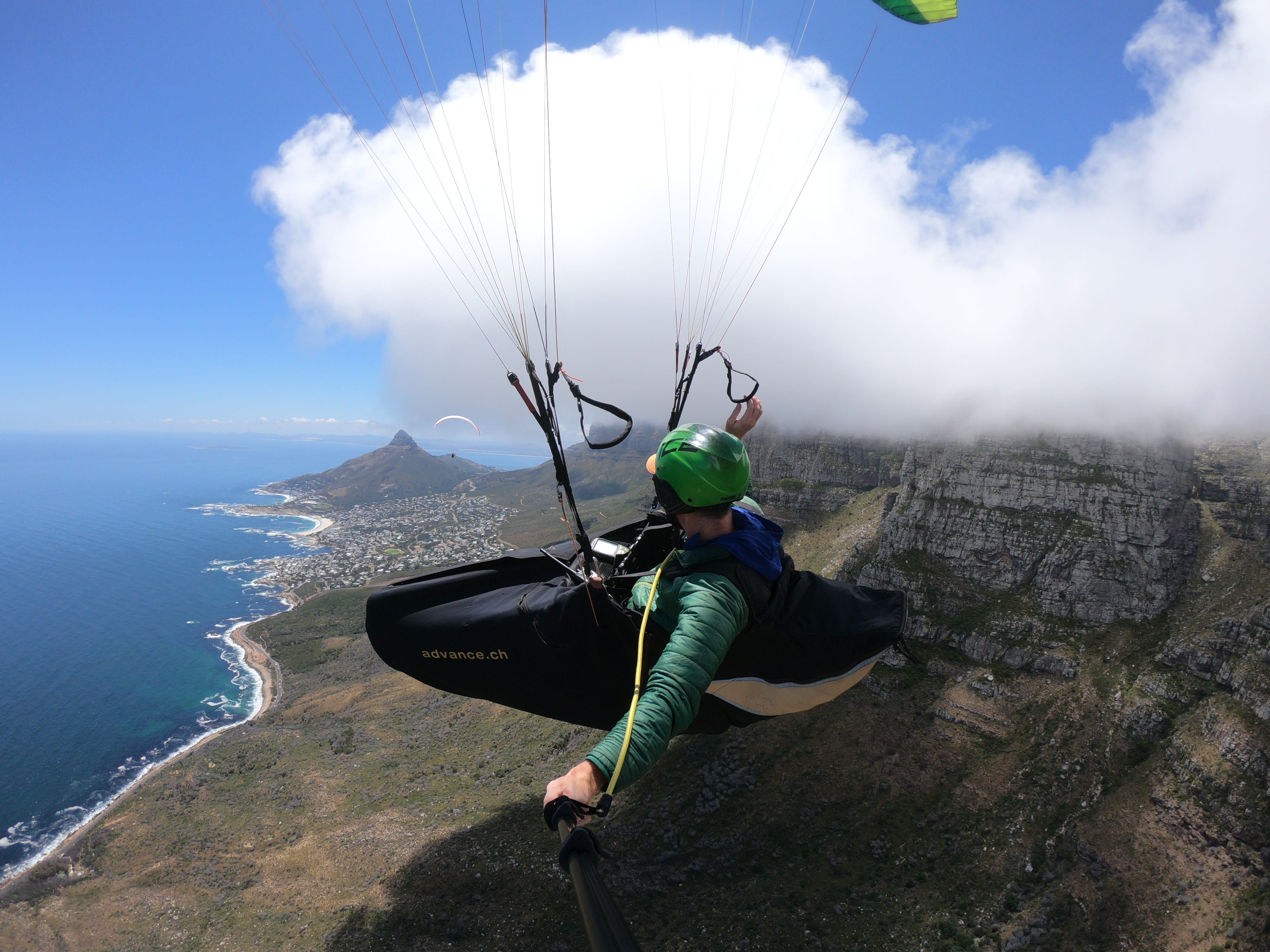
I'm filming a Q&A for YouTube this week. Got a question about fear, flow, or the mental side of flying? Reply to this article, DM me on Substack or Instagram by Friday, and I'll answer it on camera.
The two years between 2022 and 2024 challenged me in a way I didn’t expect.
Not because I stopped flying during this time. But because I was forced to confront my self-image and re-derive my sense of self-worth, which had become tightly bound with my paragliding performance.
There I am living in a foreign country trying to make sense of this new world COVID has given us. The local paragliding legend introduces me on Facebook as an instructor who’s set records back in his home country. My worth a jenga-tower built by each of those kilometers.
But external achievements are never enough. I need to prove myself again to remain worthy. To be accepted into this community and have any chance to continue my paragliding career I need to show “how good I am.”
So naturally, I set myself the goal of flying 100km across the flats from the local 400m high XC hill, in an unfamiliar country, in unfamiliar conditions.
I attempt to go XC from this site on two occasions. Unsurprisingly, I don’t get very far.
I’m a failure.
Maybe I’m just not good enough.
All of this is happening behind the curtains of my subconscious mind. My misguided sense of self-worth. The desire to prove myself. The need for belonging, acceptance, and recognition. The desperate need to get out of the warehouse I now find myself in and return somehow to my paragliding career.
A low hum of anxiety keeps pulling me out of the present. I’m shackled by a lack of income and a subtle yet powerful state of fear.
I fall into a deep depression, I don’t fly again for another two years.
In flow science, we refer to this egoic state of mind as “being in the red.”
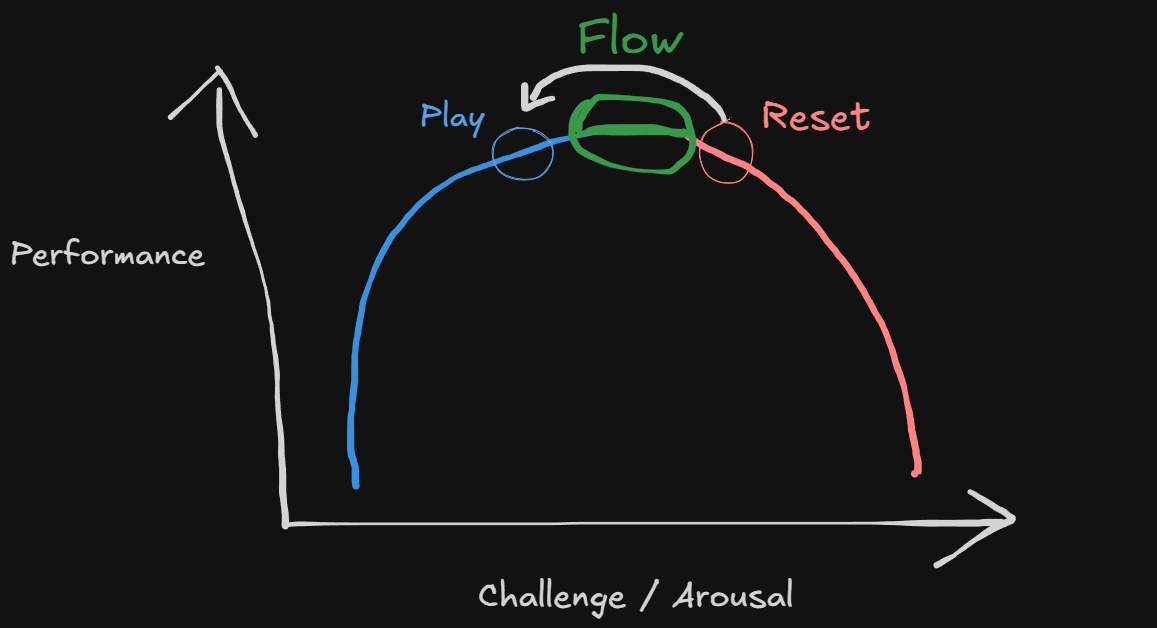
When you tip into the red zone you are typically in a future state; distracted, conflicted, and stressed out.
This is the danger of goal-setting.
Forget About Goals
When you fixate on an external achievement (winning, flying the furthest, flying an X number of kilometers), there is an inevitable cascade of unhelpful thinking.
Instead of dealing with whats right in front of you, your mind is transported to the future. You become inundated with fear-based thoughts - expectations, comparisons, and what ifs - which lead to the threat responses of avoidance, anxiety, and unhelpful stress.
What if I fail? What if I lose? What if people don’t think I’m a good pilot?
Once a fixed outcome is set, success is attached to the point of its achievement. I’ll be happy/successful/accepted… when I reach this outcome. I’m sure you can see the problem here. With your state of being deferred to a future outcome the only logical option left while you strive to achieve it, is to be its polar opposite.
Unhappy, unsuccessful, rejected…
Lisa Ordóñez, Dean at Rudy School of Management, University of California,
studied goal-setting for over two decades and concluded that the specific
side effects associated with fixed outcome goal setting, include “a narrow
focus that neglects non-goal areas, distorted risk preferences, a rise in
unethical behaviour, inhibited learning, corrosion of organizational culture,
and reduced intrinsic motivation.”
This may come as a surprise to you. Prevailing wisdom tells us that to make progress in life we must set specific goals.
But eventually you realise that your results have little to do with the goals you set.
As James Clear writes:
1. Winners and losers have the same goals
The Problem: We suffer from survivorship bias. We focus entirely on the people who won (like Olympic gold medalists or successful entrepreneurs) and mistakenly assume their goals made them successful.
2. Achieving a goal is only a momentary change
The Problem: Reaching a goal only changes your life for a single moment. If you clean a messy room, it satisfies the goal temporarily, but if you don’t change your sloppy habits, the room will quickly become messy again.
3. Goals restrict your happiness
The Problem: Goals create an unhealthy “either/or” conflict: “Once I reach my goal, then I’ll be happy.” This mentally delays your joy and forces a binary choice where you either succeed or become a failure in your own eyes.
4. Goals are at odds with long-term progress
The Problem: Goals often create a “yo-yo effect.” Many people work hard for months to finish a marathon, but the moment they cross the finish line, they stop training because the immediate motivator is gone.
If not goals, then what?
The Way of Flow
It’s late August 2024. For the first time in two years I’m flying again - soaring above that 400m XC hill. The air is icy. The lift is light.
I’ve made no plans to go anywhere today. No ambitions. No goals.
After a period of soul-searching, immersed in philosophy, daily swims in icy lakes, and regular forest walks, I’ve made the difficult decision of leaving my son to return home to Cape Town.
Today, all I want to do is fly.
My vario produces a slow and gentle beat. Music to my ears. Pointed into wind, I slow my green Cayenne 5 right down. I weight shift gently to the left and to the right in my old Impress 2+. I can feel the stretch of the neoprene skirt against my legs, the crisp air on my nose, the pressure of my beloved wing through my gloved hands.
As I drift side to side, almost hovering in place, I gain tiny margins of altitude. My focus is completely locked on to this little challenge. Can I gain half a metre more?
My awareness expands. It all feels so real. It all feels so natural. It all feels so effortless, spontaneous, and somehow right(?)
I’m everywhere and nowhere. I’m nothing, yet somehow whole. I am one.
What I can only describe as a knowing blasts instantaneously out from my core and engulfs my entire being, a supernova of insight expanding infinitely in all directions. I’m in flow.
It’s all so clear now. This is why I started flying.
The true path is to reject the external factors of comparison and achievement.
But how?
A Return to the Blue
This discovery was difficult to grasp or put into words. I had felt it but could hardly explain it. Yet it was so familiar.
I know you’ve felt it too.
All I knew was that, somewhere along the way, I had become lost. Lured away by the promises of glory, I’d left my rich boyhood dream of flying for something shallow. My self-worth was tied to my achievements. My motivation tied to external results. I was bound by the need prove myself worthy. I’d been stuck in the red.
Ignited by the experience I vowed to learn as much about this state of consciousness so that I could enrich my own life and help others.
What I discovered was simpler yet deeper and more profound than I ever would have imagined.
A state, well studied in psychology and neuroscience, called by many names across cultures and ages, at the core of our very wellbeing. A state that we all experience in abundance as children, a state available to all of us right here, right now. A state so powerful yet, somehow, so elusive.
And the good news is that, contrary to popular belief, you can intentionally bring more flow into your life with many good reasons to do so. Going from external toward internal motivation gives you the power to determine your value, your worth, and the quality of your experience.
Your core solidifies and your confidence grows.
Ironically, by not focusing on performance your performance improves.
And it all starts by putting flow first.
The Flow Mindset
“…optimal experience is something that we can make happen.”
~ Mihaly Csikszentmihalyi
You may have heard that flow is impossible to attain if you focus on it. But this is a myth.
In research review of flow in athletes, 72 percent of athletes reported that getting into flow was within their control and 81 percent reported they could restore flow after momentary disengagement.
In research examining the effects of educating people on flow results consistently showed flow and performance scores increase by over 30 percent when putting flow first.
Why?
Because when you understand and prioritise flow you fundamentally shift the way you approach an activity, priming your mind and body to get into the zone.
Like most people, you might think flow is reserved for the elite and out of your daily reach.
Albeit profound, flow is simply a natural state of harmony. An alignment of the body and mind (and soul?). There is nothing to add. No new skills to learn. No tricks or hacks.
Instead, the flow journey is more about deepening your relationship with yourself and reducing the inner conflict caused by adopted egoic patterns and habits.
The flow approach allows you to drop goals and instead focus on systems - processes to which you can apply small changes that compound over time.
This means instead of telling yourself you’re going to try and fly 100km today (an outcome out of your control) you rather guide your attention to the quality of the experience, your learning, and your growth.
The flow approach is one that values internal experience, and prioritises learning, growth and personal excellence.
And as you will remember this shift to the internal is where you develop your inner core which grows your self-confidence. You become more secure in the uncomfortable (like bombing out) and your results cease to be attached to your self-worth.
This core and your personal power grows when you put flow above achievement.
It is helpful to remember that flow is a subjective experience, an actualised process, not an outcome in of itself.
A flow mindset is a kind of ideal, an approach towards your paragliding. One that - among others - values connection, mastery, learning, growth, and fulfilling your potential.
A flow mindset sets the intention but to be in flow you need to be 100 percent focused on your task. You don’t want to be focussed on flow when you’re flying, you want to be deeply connected, without thought, to the wing and the air.
Try This
The next time you go out flying be mindful of your intentions for the day. Are you feeling comparison, anxiety, superior, inferior, distracted, conflicted, or any unhelpful thoughts?
You’re operating in the red.
As soon as you recognise this, you can do something about it.
A mantra that has helped many of my coaching clients is Learn, Grow, Flow.
Instead of trying to impress, or beat, or hide, let go of your outcome and egoic agendas and focus on what is in your control, your process, your learning, and your growth.
Mentally repeat Learn, Grow, Flow to shift your attention from an outside-in self-focus towards the task at hand, priming yourself to be ready for flow.
This doesn’t guarantee flow, however.
Many of your habitual thinking patterns have been unconsciously adopted and might feel quite normal and familiar. You are predisposed to become anxious and distracted when the perceived challenge is too high - typically caused by external or egoic goals.
The key is to start becoming more aware of your internal state. Today, right where you are, right now.
And when you notice that you seem to be in the red ask yourself…“what can I do to get back into the blue?”
If you want help putting this into practice, Wingmates is my paragliding mentorship community for flow and XC mastery. Join with 20% off your first three months with code SPRINGMATES. The offer ends Friday 9 October at 21:45 UTC.
Happy flying🪂
~ Grant