

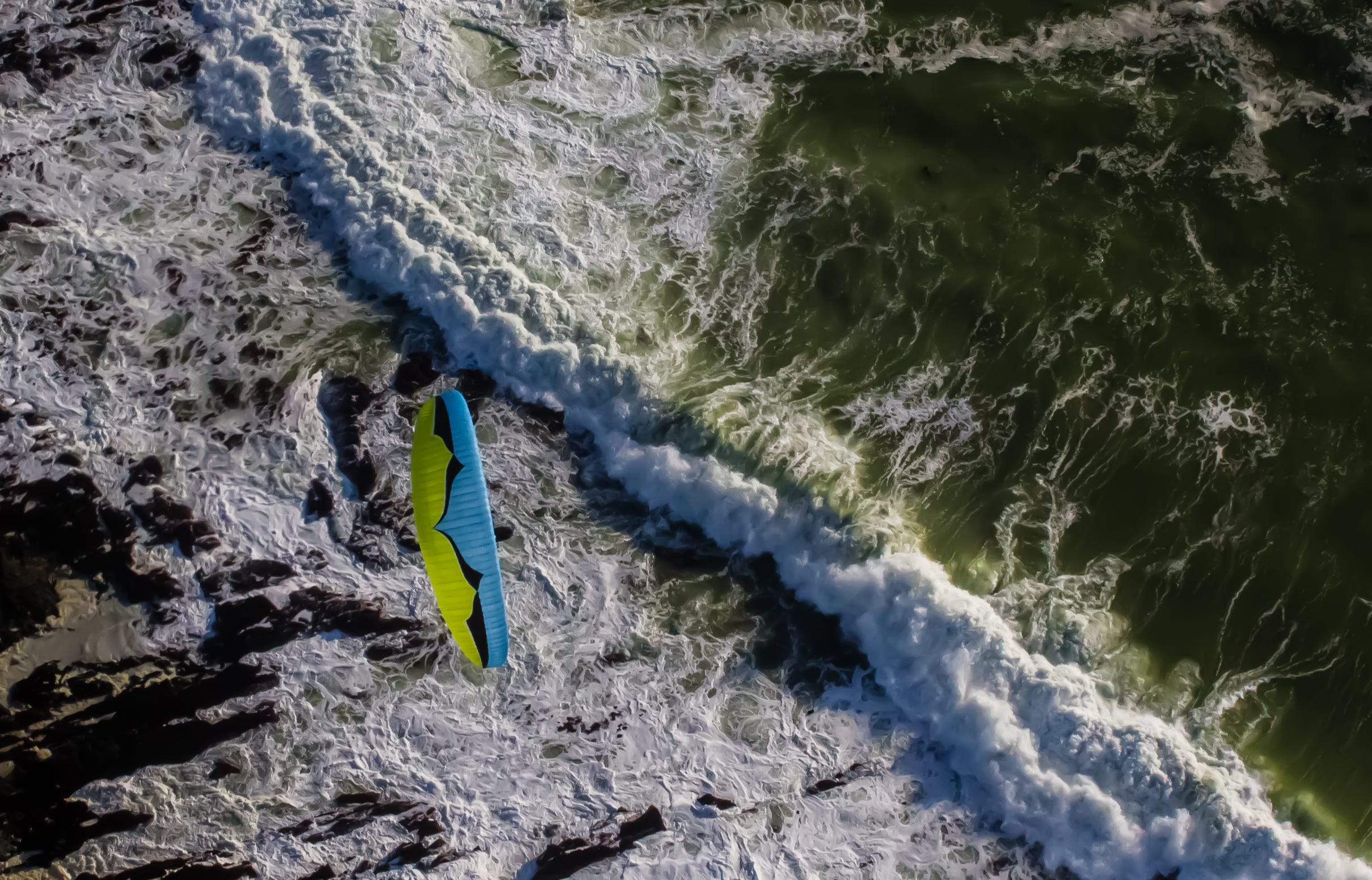
Flying for outcomes is like trying to fly while staring at the sun. It blinding.
I used to feel like a failure anytime I missed a goal. Even by a single kilometre. When I flew 99 instead of 100km. When I placed second instead of first.
You see pilots celebrated and respected and loved for winning comps and setting records. Deep down you might feel yourself wanting that.
None of these things are inherently bad. They help direct your attention and provide feedback on your progress. But as useful as they are, nobody really wants to fly 100km, they want what they think flying 100km will feel like. The metric becomes a proxy for something that’s much harder to measure.
You can’t see how the pilot felt flying that record flight, or what risks they took to get there.
There's a story of a pilot that was sucked into a storm cloud. The climb was so violent he nearly lost consciousness. He got lucky. He posted his tracklog anyway. Unaware of the reality of the flight, the online community cheered his thermalling skill. His experience reduced to numbers on a screen.
Are we feeding a social algorithm that is silently optimising for the wrong thing?
I believe we are.
In this essay I want to share a few ideas that I hope will help you shift your aim and focus on what’s really important, so that you can rediscover what it takes to master paragliding effortlessly.
1. Paragliding feels effortful when focus is external
Modern society is obsessed with numbers and status.
Money. Fame. Fanatically arguing over who’s “the best.”
Numbers and rankings promise clarity, but they collapse all nuance into a measure of success devoid of any soul.
And these finite ideals have seeped their way into paragliding.
What started off for most as a childhood dream to fly, echoing the dreams of humanity, quickly turns an inner desire for freedom into a measure of worth.
So you set your sights and aim for a number or result you think will make you worthy as a pilot and satisfy your natural human yearning to belong.
You try really hard. But every time you fail your confidence takes a knock. You stand around on takeoff “waiting for conditions to improve” when subconsciously you are protecting yourself from being seen as a “bad” pilot.
Craving external recognition you increase your risk tolerance to get those extra few points. Sometimes it works. You get your hit of dopamine from “winning the day.” But this feeling disappears as quickly as it comes. Other times it doesn’t. So you try harder. Chasing ghosts. The harder you try the more frustrated you become.
Why does it look so effortless to some, like it’s easy for them?
It must be their talent. Their gear. The secrets they know that you don’t. Right?
I want to be clear, I’m not sitting on a high horse here. I’ve been in the trenches with this stuff, and still struggle with it occasionally. I’ve dedicated years of my life trying to understand it so that I do my best to steer clear of these traps and help the pilots I coach do the same.
I’ve seen so many pilots either hurt themselves or quit, destroying their dreams in the process. I don’t want that for you.
If any of this stings it’s because it rings true.
Face it. You want to be happy. You want to master paragliding. You want to belong. We all do.
But chasing outcomes ruins it. Comparison ruins it.
And for good reason.
Effort spikes when you watch yourself from the outside-in. Your actions become forced when you try to achieve an external goal or look good to other pilots.
This self-focus (how you look to others) is at the heart of Egofear and it doesn’t just misdirect, it blocks flow.
A hallmark of flow is ego-transcendence. The parts of the brain responsible for creating your sense of self are downregulated. The chatter in your head stops. You become less self-conscious. The boundary between you and the world dissolves, you feel one with your wing.
That’s why flow feels soooo good.
But self-focus, the outside-in self-monitoring, breaks that harmony. Chasing the external forces you to watch yourself doing it as you measure yourself against your goal and your peers.
The watching, self-judgment, and the metrics, all become distractions, stifling the soul that makes freeflight (and life) truly magical.
This rumination is not a flaw, it’s a signal that your aim has drifted outward.
The question is whether or not you’ll do the work to develop the insight needed to free yourself.
You need to stop trying harder.
And you need to question what you’re aiming at.
Because you’re aiming at something, whether you realise it or not.
2. Your ideal is serving a borrowed social algorithm
Humans desire a tribe, status, and belonging.
Your brain is primed to adopt the values and beliefs of the culture around you because if you don’t, you risk being rejected and cast out.
These beliefs shape your identity. Your identity informs your aims. Your aims orient your mind, and guide your actions.
Your psyche needs an aim to move towards. Without one, the mind wanders toward chaos.
Where you focus your attention and what you spend your time on is being determined by deeply held beliefs.
But they’re mostly borrowed. Since your worldview is shaped by the people around you and the information you take in.
Social media algorithms curate your feed into a digital worldview based on what you engage with.
Social algorithms curate your worldview based on who you associate with and what they reward - usually determined by the loudest and most convincing people in the room. Their opinions, online and in real life, subconsciously shape who you become and how you act.
Beliefs. Identity. Aims. Actions.
The mind is a story engine. And the ego is the evolving life story that you create and call “me.”
Why does this matter?
Because if you don’t consciously select aims based on your values, you can easily get stuck in hand-me-down status games that you think you’ve chosen but leave you feeling empty.
Status games are zero-sum by design. There can only be one winner. There will always be someone better, guaranteeing a perpetual sense of not being enough.
Open XContest after any flight and you’ll feel it instantly. Your flight is already ranked, against pilots you’ve never met, on days you weren’t flying, in conditions you weren’t in. Somewhere there’s a bigger triangle, a longer flight, a higher climb. There always will be.
When results become an end in themselves, the tool meant to serve the aim ironically wrecks the performance it was built to improve. Like sleep tracker anxiety keeping you awake at night.
And if you’re not careful, these metrics quickly begin to fuse with your identity and self-worth. The moment you measure yourself against a leaderboard, the feeling of “not being enough” is inevitable. When your performance gets wrapped up with your identity, every flight turns into a reflection of who you are.
Metrics become symbols of your position as a “good” or “bad” pilot. Bombing out becomes an attack on the story you call “me.” Instead of being a practice where you improve yourself, it becomes a status game where you need to prove yourself.
And chances are you’re not comparing yourself to who you want to be, because it’s easier to compare yourself to who others appear to be.
Advertising has exploited this for decades, selling ideals crafted to make you feel worse about yourself and positioning their products as the solution to a problem you don’t really have.
Social media is even worse because it looks like real life.
Without a chosen ideal, you unknowingly take on the ideal of the influences around you.
This comparison isn’t new or unique to paragliding, but it does mean you’re not measuring yourself against something you choose.
You’re measuring yourself against a moving, borrowed standard. A standard that belongs to someone else, shaped by the culture around them.
The second you start building your own ideal, comparison loses most of its power.
Because you can stop looking left and right. You start looking within.
You don’t decide whether to have an aim.
You decide which ones are yours.
Soon I’ll share what a chosen ideal actually looks like, but first we need to tackle what holds most pilots back.
3. Fall in love with failure
Children who grow up getting praised for results link reward with being seen.
Every gold star, good grade, trophy, or applause, fires a little dopamine that wires those things together.
Do. Get seen. Feel good.
Being noticed becomes the reward. Social value gets tied to the results. What you do becomes fused with who you think you are.
And that’s a fragile way for an identity to be built because motivation drops when the applause stops.
In a well-known experiment children were promised rewards for drawing. A week later they were drawing far less than normal and enjoying it less. The reward replaced their love for making art. Drawing stopped being something they did for fun. It became work done for an external benefit.
I’m sure you can already see the link to paragliding.
A childhood dream comes true. The community applauds “good flying” measured by arbitrary metrics.
Paragliding becomes more a game of comparison focused on distance, points, and looking good to others, than one of freedom, fun, and adventure. Flying stops being the reward in itself. It becomes a means for getting seen.
When extrinsic reward becomes the goal, intrinsic motivation decreases, and your relationship with risk gets warped.
“Failure” becomes a threat to identity.
Bombing out is blamed on external factors. Conditions. Equipment. Other people.
The social cost of caution starts to outweigh the physical cost of pushing. When performance becomes the currency, risk vs reward transforms to risk vs social acceptance.
This fear of being rejected by the tribe is a legitimate feeling that fires the same neural circuitry responsible for physical pain.
But how we deal with it matters.
There are two main ways people deal with Egofear, and both are a type of avoidance.
Take more risk to prove yourself and avoid the negative feelings associated with failure and rejection.
Take less risk to hide your perceived flaws and avoid the negative feelings of failure and rejection.
Do to prove or don’t do to hide.
Both strategies are dangerous.
The first I believe is at the heart of intermediate syndrome, the risky stage of overconfidence many pilots go through from about 100 hours.
The stage that led me to throw my reserve.
It’s also why you might upgrade your glider too early. The added performance to mask your perceived shortcomings and the ego-boost that saying you fly a C or a D gives you.
On the other end of the scale you might avoid takeoffs, people, conditions, even ground handling that is well within your ability, just to avoid looking bad. To avoid looking like a newbie. To avoid the shame of appearing foolish.
But this keeps you exactly where you don’t want to be. Your skills don’t improve. You fly less. You become rusty. And when you do fly you make mistakes because you haven’t practiced or developed your relationship with fear, feeding the cycle of belief that you are “bad” at paragliding.
It becomes a self-fulfilling prophecy.
If I find myself avoiding something, whether it’s writing an essay for you, standing around on takeoff when I want to fly, or having a difficult conversation, I ask myself “what am I afraid of?” The culprit is almost always Egofear, a threat to a fragile part of my identity.
But I want to let you in on a secret.
The moment you realise that nobody cares as much as you fear is the moment you take your first flight towards freedom.
When you can decouple who you are from what you do, you give yourself permission to look bad, and be ok with it.
As the saying goes:
The fool is the precursor to the saviour.
Of course you’re going to look foolish when starting out. Of course you’re going to bomb out. Of course you’re going to botch your takeoff. How else are you going to learn?
That’s the price of entry. Accepting that is what makes growth, mastery, and meaningful achievement possible.
By shifting the focus to your inner experience and personal growth, to learn - grow - flow, you start to realise that paragliding has nothing to do with being better or worse than others, but rather a practice of improving the self.
But that doesn’t mean it will be easy.
In fact, failure, struggle, and looking bad are not only unavoidable, they’re desirable.
The discomfort is a feature not a bug.
What feels bad now leads to what is desirable later.
Elizabeth & Robert Bjork call this desirable difficulty, a process of learning where the unpleasant present forces the brain to work harder to encode what it’s learning. Challenge will slow your visible progress. You will look and feel like you’re failing, while building skills that will last.
But a difficulty is only desirable if it can be overcome with effort. Beyond that, it isn’t difficulty. It’s danger.
Making practice hard is the point. Getting into situations you can’t handle isn’t.
Practice that’s always easy reinforces nothing. Comfort is a trap. The struggle of stretching yourself bit by bit is what makes learning stick.
You take on a self-chosen challenge, struggle, and eventually break through. That success fires dopamine too. But this time it’s triggered by your own effort, not because someone saw you do it. And because the reward is generated by the doing itself, it reinforces the doing. Practice becomes the reward.
Struggle. Overcome. Feel good.
Effortless mastery isn’t the absence of difficulty. It’s the result of compounding struggle. Every hard-won hour of challenging practice is a deposit, and flow is the interest it pays.
As Csíkszentmihályi argued, the self grows more complex in flow: more differentiated, more uniquely itself, and at the same time more integrated, more connected to the world it’s acting in.
A chosen ideal isn’t a fixed end state, it isn’t a goal. It’s a direction. A north star. Mastery, the ever-deepening practice of improving the self, is the one ideal that comparison can’t touch, because your journey is unique to you.
The perfect ideal is, therefore, infinite and imperfect.
4. What effortlessness actually looks like
When you have a clear ideal, your actions either serve it or they don’t.
Effortlessness arises through practice and through the steady reduction of internal conflict.
Say your ideal is to manage any takeoff with ease, confidence and poise. You won’t need to debate whether you’ll go ground handling today. The action serves the ideal.
You’ll find yourself investing in your mind and skills instead of trying to rush your progress by buying performance.
Then you’ll want to reflect and understand yourself more deeply, eat healthier and get fit for long XC walkouts, study the weather instead of doomscrolling.
Mastery cannot be bought, rushed, inherited, or stolen. It can only be achieved through consistent and deliberate practice.
If you’re ground handling and studying with desirable difficulty, challenging yourself optimally while flying, and moving towards your chosen ideal, then you’ll experience what it means to be effortless more and more.
That tricky takeoff you nailed without thinking. The low save where the world melted away and you became one with your wing. The intuitive voice that guided you to the next thermal when you needed it most.
However, it won’t be easy.
And without enough internal fuel generated through the struggle-reward loop, many pilots lose steam, especially when emotions like fear or shame enter the picture.
The flow warrior is not someone without fear, or someone who doesn’t make mistakes. They are the pilot who has clarified what they value, grounded their identity outside of their results, and can therefore turn toward what’s hard and embrace failure as part of their unique journey.
Threat turns to challenge, and inner intelligence and growth are prioritised over outer performance.
I recommend writing down the answers to these questions on a piece of paper.
Ideal: What do you want your paragliding life to look like?
Values: What are your three reasons for flying? Now ask why each one matters. Keep going until you hit something you can’t explain further. That’s the value.
Action: What would you do differently if you lived by them daily?
This will give you clarity on your direction. There is no finish line. Your vision will evolve as you do.
But be warned, clarity alone is not enough. Fear in all its disguises will still get in the way. There will be mornings when the direction is perfectly clear and you still don’t want to go. Days when the fear is present, the shame from last time is present, and every reason to stay home is available and reasonable.
None of this requires you to feel ready. Action based on your values comes first. The feeling follows.
Commitment isn’t waiting for the motivation to spike or the fear to subside. It’s going out because it matters to you, even when you don’t feel like it.
Do that enough times and you’ll stop needing a reason.
It’s just who you are now.
5. Do what is required to move the needle
In the early days of my own flying career I came across an idea that shaped my behaviour. I can’t remember exactly where it came from but I want to share it with you:
Do something paragliding-related every day.
If you can fly, fly. If you can’t fly, ground handle. If you can’t ground handle, study weather or read about paragliding.
Immersion is the key.
The pilots that make paragliding look effortless aren’t trying harder. They’re not more talented than you. The difference isn’t their gear.
They’re aimed at a meaningful ideal and they’ve soaked themselves in the daily practice needed to live it out.
Their motivation isn’t outside-in, but inside-out.
To them paragliding is a practice. A way of life.
An expansion towards who they are becoming.
When you adopt a flow mindset and put your learning and growth first, frustration and failure become easy to accept as part of your unique journey.
You don’t fly to prove, you fly to improve.
You see the struggle as a worthy challenge. You take every opportunity to practice even on the “bad” days because you know you’ll learn something.
You set small challenges just beyond your comfort zone. Even if it means you’ll bomb out and “look bad.”
And you always fly with gratitude.
Even the shortest flight is a miracle. We’re privileged to be living in a time where we can pack a flying machine into a backpack. To live out our childhood dreams. To realise the aspirations of humanity to fly.
Never forget that.
I set multiple local records on an EN B that many pilots on EN Cs, Ds and CCCs haven’t surpassed. I don’t say this to brag. Only to highlight that gear doesn’t matter nearly as much as pilots like to think.
I couldn’t afford better gear. I had been struggling with addiction. Paragliding gave me something to live for so I poured myself into it.
Those records didn’t come as a result of trying harder. In fact they weren’t even my intention, they just happened. I wasn’t trying to win or beat anyone. I wasn’t aiming for a number.
I just wanted to fly and keep flying.
The struggle-reward loop helped me slowly regain confidence. I discovered a freedom and perspective that I struggled to find in ordinary life. I became more connected with real life and with myself.
Paragliding changed my life.
I’m sharing this with you because I see many of my students fall into the comparison trap. I fell into it too and lost my way for a while.
What I’ve realised is that mastery is positive-sum. Unlike competition, it doesn’t require there to be losers. Skill compounds regardless of what anyone else does.
When we drop the status frame we all become collaborators, working on our own transformations so that we can raise the collective.
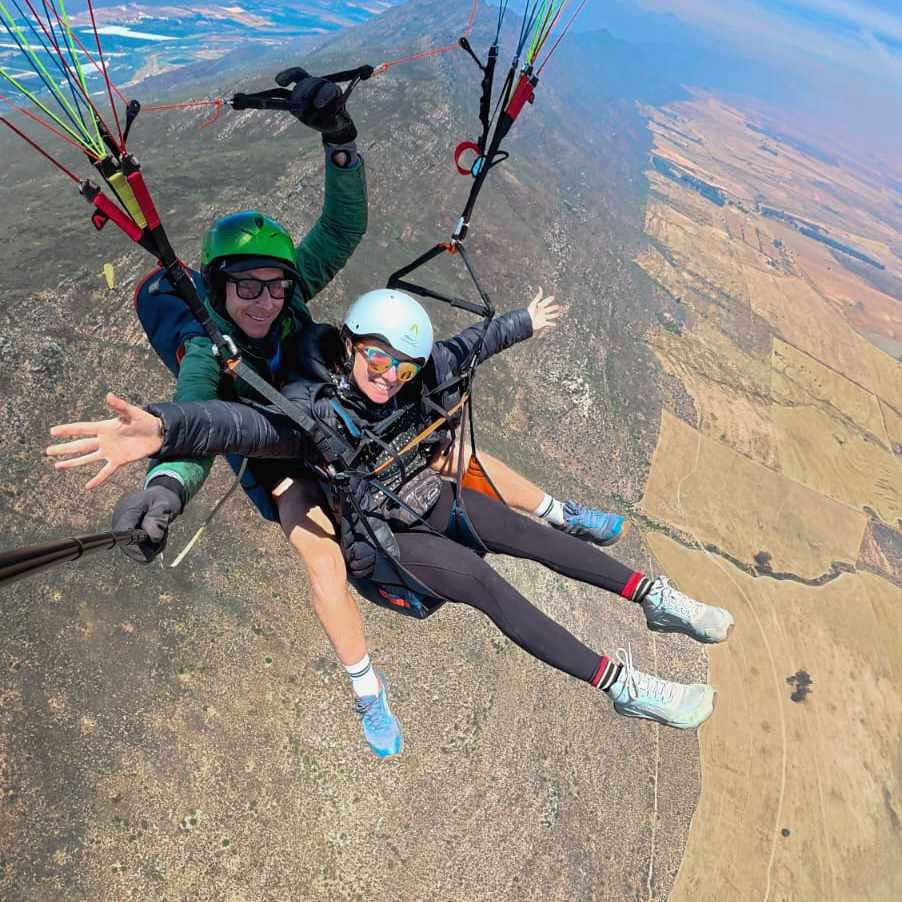
Flow emerges when you return to play.
Choose your ideal.
Act before you feel ready.
Commit to the compounding reps.
Let who you become evolve through practice, not results.
What small action will you take today?
P.S. Wingmates, the community where we practice this stuff together, is currently full. To enter when doors reopen, join the waitlist.
Thomas, this is exactly it. That inside-out flying is what it's all about, noticing what you felt before you judge the result. Opening yourself up to all experiences as part of your own unique journey: they're just feedback so you can fly more intuitively next time. Have an incredible time in Kruševo, sounds like a great place to do that. Happy flying 🪂
What an inspiring and mind opening essay, Grant. I'm in Kruševo at the moment on some xc flying and your thoughts & ideas uttered in the essay accompany my flying and above all debriefing reassessments of the daily challenges accomplished or failed. Flying from the inside - out rather than outside- in is so much more rewarding. And "failures" are essential for progressing and learning how to fly more and more intuitively. Greatly appreciate your sharing your concepts ... keep up your inspirational work, cheers Thomas