

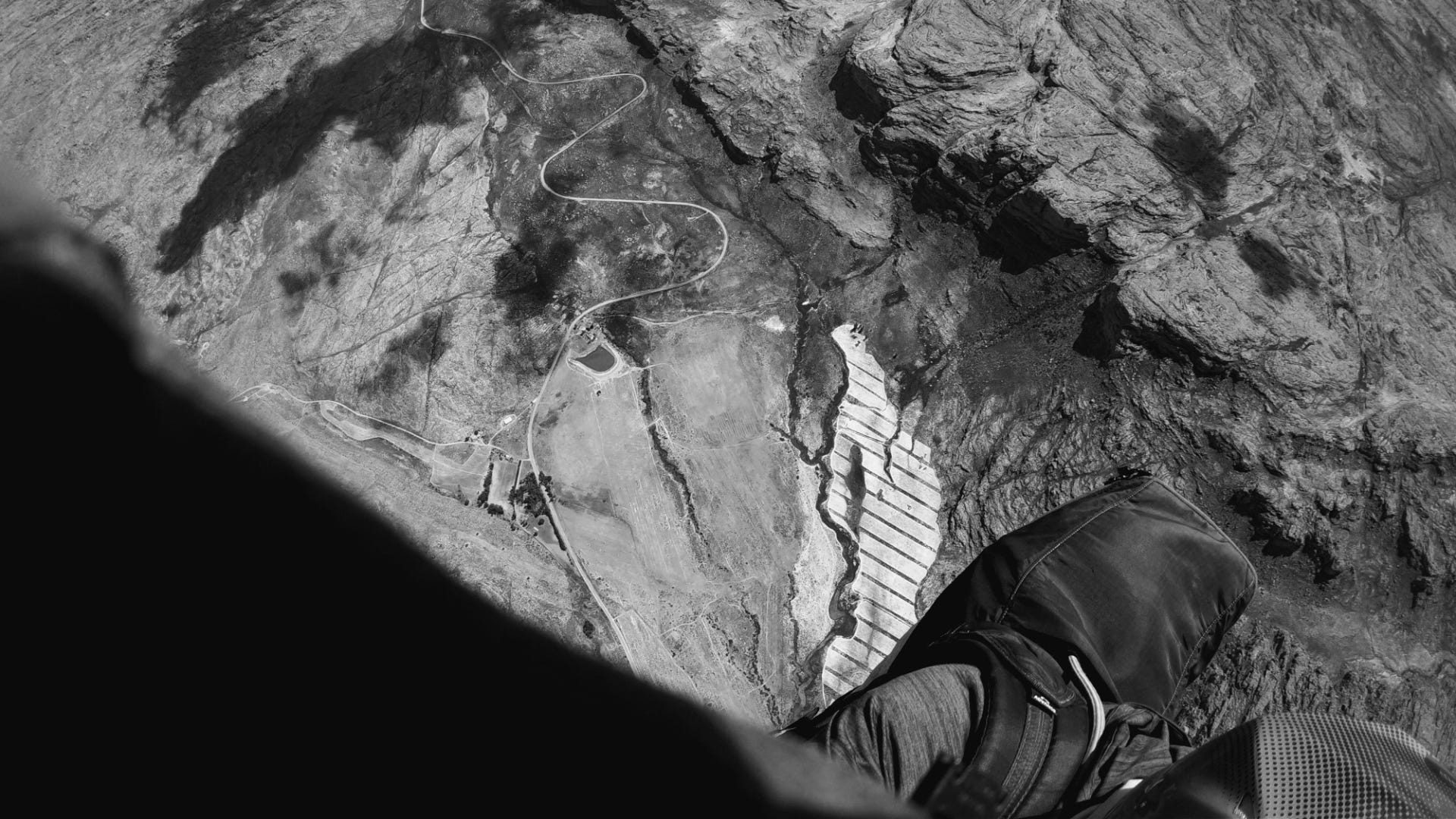
Almost every pilot I meet has struggled with fear.
But humans have a terrible relationship with it. So we treat it as the enemy. Try to block it out, breathe it away, avoid people or takeoffs, anything to make it stop. But the harder we fight, the more it runs the show. No wonder so many pilots feel stuck.
Here’s why fighting it backfires, and what to do instead.
I see a common pattern in the pilots I coach. After reaching a personal limit — altitude, turbulence, a busy takeoff — the feeling of their nervous system getting charged for action triggers negative thoughts causing internal friction and anxiety. Unaware, the pilot misinterprets the signal as a threat. They become distracted and stuck in a state of what-ifs, triggering the nervous system more, and enter into a self-perpetuating loop of overthinking and distress. Tightening up, focus narrows, breathing shallows and performance drops.
As they enter a fear state the pilot will usually try to white-knuckle and fight it through, flee the scene, freeze, or avoid the situation that causes the feeling entirely.
This happens in daily life too. Often passing under the radar of your awareness but showing up as avoidance. That important conversation you’re meant to have. That job application you haven’t submitted. That healthy habit you’ve been meaning to start.
The sensation of your body charging up, when read as a threat to your body or ego, becomes anxiety which gets reinforced the more you resist it.
The problem was never the signal, it’s your relationship with it.
If you find a little voice starting to pop up resisting these ideas I’d encourage you to give it a chance - this is the same mechanism of avoidance at play and is a sign of a primitive part of your being just trying to do what it does best and keep you safe by resisting change. Change signals danger. But avoiding change is a surefire way of keeping you exactly where you are.
This might be a little hard to wrap your head around at first, most of us have a poorly developed fear intelligence. But the sooner you start to notice your avoidant behaviours as a symptom of this subconscious process the sooner you’ll be able to make the changes needed to harness the energy and grow from it.
Feel the Fear, Don’t Fight It
Resistance comes in two main flavours, avoidance and suppression.
Avoidance is leaving the thermal when you reach your altitude limit, standing around on takeoff when it’s good to fly, not flying certain sites within your skill level because of certain people being there.
Suppression is trying to just stay calm and breathe the feeling away, jumping in your harness early, gritting your way through a flight but landing depleted from the stress and mental exhaustion.
Neither strategy leads to growth, and neither addresses the real problem: an underdeveloped fear intelligence, a poor relationship with intensity, and a lack of self-trust. All of which destroy your chances of flying in flow and hold you back from becoming the pilot you dream of becoming.
If you’ve been struggling with this for a while, it can start to feel hopeless. Many of the pilots I coach have been close to giving up. I’ve been there myself. But here’s what changes things. The problem was never you, and it was never the fear. It’s the relationship you have with it. And a relationship can be changed. Not by trying harder at what hasn’t worked, the gritting, the avoiding, the white-knuckling, but by changing how you meet the feeling in the first place. That takes patience, and some honest inner work. But the shift is closer than it feels, because it doesn’t depend on the conditions, or the other pilots, or years of experience you don’t have yet. It starts in your mind.
Change Your Mind
The first thing to realise is that the charge you feel - the butterflies, the raised heartbeat, the sweaty palms - isn’t a problem to be solved. You may not be comfortable with it yet, but that arousal is simply your body activating in the face of something important to you. It’s a neutral signal alerting and preparing you for action.
In turbulence, the activation sharpens focus, drives attention into the here and now, and prepares the body-mind to fly as one, in flow. The pilot who allows the energy to charge and flow through them flies more fluidly and with less effort.
But when this energy is resisted your attention largely goes to fighting it. You become distracted, tense, and rigid as you try to block the feeling and look for a solution to “the problem”. This inner conflict creates friction that breaks the body-mind harmony indicative of a flow state. The mind starts to wander. You start to look for the cause of this feeling - those carabiners don’t look so strong now do they? This causes your threat detection system, the amygdala, to fire another alarm, which releases more bioelectric signals in the body and brain and the only way to stop it is either to use more energy and grit through, or to eject from the situation entirely.
The pilot who avoids the feeling never learns to work with it. Every time you run, you prove to yourself that it’s unmanageable. And because you never stay with it long enough you rarely get to experience its magic.
Avoidance is sticky for a reason. The moment you back off, you feel relief and are rewarded by the brain for staying safe. The behaviour gets logged: running worked. So next time the feeling rises, the pull to run is stronger. Each retreat trains the next one. Worse, the anxiety never gets disproven, because you never stay long enough to discover that the situation was survivable and that you were capable of handling it. That’s the real trap. Not the feeling, but the negative-reinforcement loop you build around it.
The trigger - the altitude, the turbulence, the carabiners, the takeoff, the people, the failure, whatever - becomes the reason for the avoidant behaviour. The justification is rational and makes sense. But this is a symptom of the negative relationship that we have with the energy that charges up your body when the stakes are raised. And whether these stakes are seen as a challenge or a threat comes largely down to perception.
Now you might be thinking: but what if I’m genuinely in over my head — in turbulence, or on a glider I’m afraid of? “Learning how to have an intimate relationship with fear is one of the best things you can do,” explains Dr Andy Walshe, ex-director of high performance at Red Bull, on how extreme athletes meet frightening situations. Even when the stakes are life-or-death, the same thing holds: you become intimate with the thoughts, emotions, and sensations so you can loosen your resistance, let them go, and regain control of your inner experience. You relinquish the analytical mind to the intuitive action of the body-mind, feel the energy and let it flow through you, and operate at a level beyond thought — what the samurai call mushin — when you need it most.
And if you can safely back out — top-land, land, choose not to launch — and the limit is real, that’s not failure. That’s listening. Because fear of the glider, or of the conditions, is data. It’s telling you the challenge is too high for where you are right now. Heed the warning. Then, once you’re on the ground, do the real work: look honestly at where that fear is coming from — ideally in a community like Wingmates, where you’re not sorting it alone. A coach can help you find the optimal challenge — hard enough that you grow, not so hard that you freeze.
We are energetic beings. Your body is alive with it — the charge that builds when something matters, the bioelectric signals firing across every cell in your body. You are energy. Learning to connect with that energy, and to trust the capabilities of your body-mind and its intuitive intelligence, is at the heart of dropping into flow when you need it.
This isn’t unearned trust. It’s a different relationship with what’s there right now. Intimate enough to feel it. Practiced enough to let it go. Focussed enough to shift attention back to what matters — the action right in front of you without being distracted by the noise of suppressed sensations.
Instead of fighting the activation, you learn to feel and modulate it. Keeping you in the zone needed for optimal performance.
And it’s available to every pilot, at every level, in the air today. You are capable of far more than you realise. But the only way to get there is by focusing on the 80% that matters which 80% of pilots ignore - the inner game.
To help you along the way I’ve developed the CCC framework which I teach inside my course The Way of Fear that I’ll share with you briefly here.
Connect.
Connect with the feeling. Name it — say it internally or out loud: “I feel anxious.” “I feel afraid.” “I really don’t like that cloud.” You are not the anxiety or the fear. You are the pilot noticing it. Then ask why it’s there and do a reality check. Is the signal well calibrated — conditions beyond your current capacity, a genuine risk? If so, listen and act. Or is this about an uncomfortable sensation, about how the flight looks, about what someone might think? Feel the feeling. Notice where it manifests in your body. Does it have a shape? A colour? Is it big or small, translucent or opaque? Don’t judge what you notice. Just notice it with a detached curiosity.
Compose.
Next, use the breath to release resistance and tension. Compose the body and regulate the nervous system with deep breathing through the nose from the belly, ending on a long exhale through the mouth for at least three breaths. Go ahead and practice this now. Let the energy spread through your body — to the top of your head, to the tips of your fingers and toes. This isn’t suppression. Anxiety met and metabolised doesn’t disappear — it transforms into the presence that makes flow possible. And composing isn’t calming down. You keep the activation high. That’s where flow lives. What you release is the fight with the feeling, not the energy itself.
Commit.
Cross the threshold and return your focus to the activity. Set a small goal and commit to the action aligned with your values. Is it important that you overcome the altitude limitation? Then commit to that action. Focus on the feeling of the glider, the sound of your vario, the wind on your face. Get out of your head and into your body, into the deep now. Reset your state by using a mantra like “I’ve got this, Let’s F*cking Go, or Bring it on.” My partner Zee likes to hum — which both adds to the playfulness required for flow and stimulates the vagus nerve much like the breathing you just practiced. Then commit to the thermal, the glide, the takeoff — whatever the action in front of you is. You’re not returning to where you were. You’re entering a new state — absorbed, effort-less, free.
You’re not trying to get rid of sensations, you’re entering a state of acceptance laying the foundations to drop into flow state rather than resisting the sensations that cause energy blocks leading to a fear state.
This is what I mean by developing your fear intelligence. And it’s the difference between a fear fighter and a flow warrior.
The fighter gets distracted, loses attention and tries to be fearless. The warrior gets charged and focused, and becomes fearfree — the intimate relationship with fear without being held back by it.
When you land — sit with it. What was the fear trying to tell you?
A skills gap: you need more hours, more ground handling, more experience in those conditions. Do the work.
A trust deficit: you don’t yet trust your wing, your training, your ability to respond. Build it deliberately.
An acceptance issue: there’s an outcome you haven’t made peace with yet. That’s the deeper work.
Three different answers. Three different paths forward. But you only find the answer by asking the right questions and taking appropriate actions.
This capacity to respond rather than react, to welcome discomfort rather than avoid it, isn’t built in the air. Cold showers. Speaking to a romantic interest. Going to a social function without needing alcohol. Choosing the glider that forces you to upgrade your skill rather than outsourcing your performance. Flying in conditions that stretch you rather than sitting them out. Every time you choose challenge over avoidance in any domain, you’re building the same relationship with discomfort that the sky will ask of you. Not to suffer but to grow. The warrior path is a daily practice.
Fear is the entry fee to anything that matters. The flow warrior doesn’t feel less of it. They feel more, alive and awake playing at the edge. Courage isn’t the absence of fear. It’s fear, felt fully, your hands on the controls, your mind focussed and free in acceptance of whatever fate brings.
Ready to transform fear into flow? That’s the work we do inside Wingmates, through the Way of Fear course and community reflection practice. Join Wingmates → (limited founding member spots left)
Want to join Wingmates for free? Refer a pilot →
3 referrals = 1 month free · 10 = quarter free · 25 = 1 year free