

If you’ve ever landed after an amazing flight only to feel a pang of disappointment moments later when you hear someone else flew further, then this post is for you…and me.
I almost ruined an incredible flight with the poison of comparison.
But I found a useful way to flip it that I want to share with you today.
The Problem
Flying represents human freedom.
But if when we fly for external metrics, to influence the thoughts of others on how “good” we are — are we truly free?
The journey—full of internal and external richness—gets reduced to a cold hard number.
In sociology, there is a term for this: Commensuration.
It’s the process of turning unique qualities (subjective experience or Qualia) into a common metric.
The Qualia: The feeling of climbing in a thermal, the bite of the cold air, the specific shade of gold in the clouds. These are unique and “incommensurable”—you can’t compare the chill of the air to the color of a cloud.
The Metric: “42.5km.”
By turning the flight into a number, you make it “comparable” to everyone else’s, but you strip away the individual essence of your experience.
You don’t see the courageous overcoming of internal obstacles. Invisible are the hours of ground handling practice, studying the weather, and life architecting that you to be available to fly this very day.
You trade the incomparable richness of your complex reality for the shallowness of a simple data point.
You become so focussed on the numbers that you forget to stop and smell the roses.
The Ineffable vs. The Metric

XC Paragliding is unlike anything else I know. It rewards us with views and experiences that very few humans will taste.
The flight I mentioned was full of moments that words cannot do justice to:
I touched the base of a cloud.
I peered into a forested mountain gorge I’ve driven past for years, while accessing a deep part of myself in a turbulent rocket of a thermal.
I crossed the flatlands with a friend, exploring the day’s thermic puzzle together.
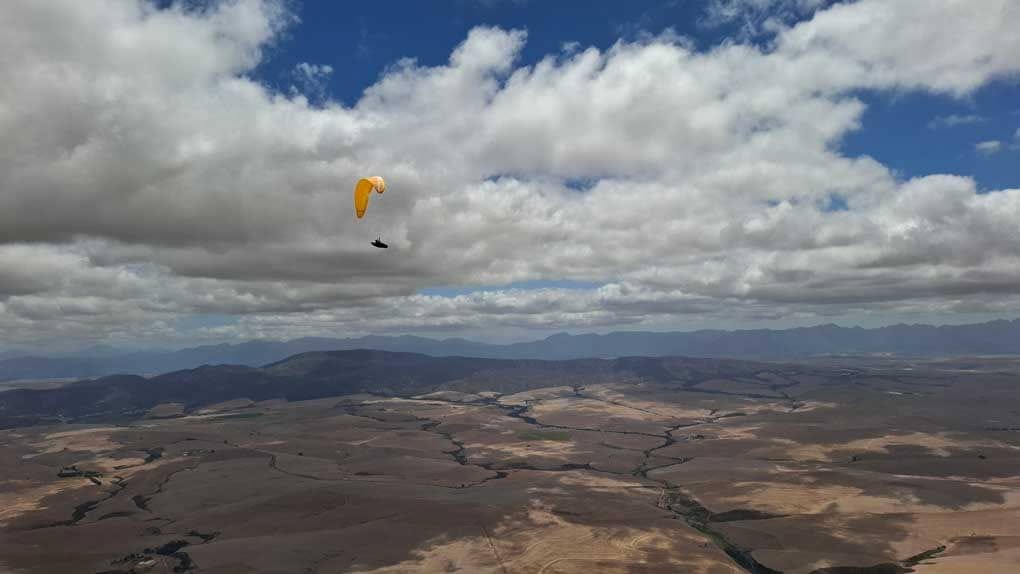
These are confidence-building, perception-expanding, soul-filling moments.
They are fleeting and ineffable.
To me, ultimately, paragliding is a means of honestly expressing yourself. Instead of trying to fulfill a concept of who you should be, remove the constraints and learn to be who you are.
In an XC flight, you cannot pretend. If you are slow and complacent, you’ll take collapses ; if you are fearful, you freeze. This Elemental Art strips away the social mask, leaving only the “honest” self.
Self-actualization is the process of removing the “noise” through humility, dedication, and practice to allow the true self to emerge.
And yet, we often let an external metric decide whose flight was “better.” This is a dangerous direction—not only because it can lead to risky decisions, but because we stand to lose something far greater: our love for flying.
The Overjustification Effect
This occurs when intrinsic motivation (flying because you love it) is replaced by an extrinsic reward (a high score, a rank, or “likes”).
Psychologically, if you start being rewarded by high numbers, your brain actually stops valuing the act of flying itself.
This is why pilots obsessed with rankings or distance often feel bad about a beautiful flight (with many learning experiences) because it was numerically short, or because someone else flew further - regardless of their subjective experience.
They become obsessed with “performance” and upgrade their gear before upgrading the most important instrument they have: themselves.
They may even quit when they can’t fly as often due to life circumstances, or they can’t get the latest gear to “compete.”
Their self-worth and status in the community becomes attached to their flying “results.” Flying far means I’m good. Bombing out means I’m bad.
If this sounds like you don’t worry, you’re not alone.
In the current paragliding cultural climate this is almost impossible to get away from. It may even be a necessary part of the development process.
However, don’t let it destroy your love of flying. There is great mystery and depth available to us all if we slow down, do some self-reflection, and dance for the love of the dance itself -not to get something.
Turning “Failure” into Success
On this flight, even though I landed at goal on my first attempt ever flying this route, I felt that “ego-disappointment” of comparison creeping in.
Using the feeling as a trigger, I stood there on the empty golf course surrounded by livestock at the back of this little South African town, still in my gear, and looked back in awe of the route I’d just traversed.
I thought back to my life when I couldn’t fly while living in Sweden—how much I would have given just to be in the air for just five minutes.
How lucky I was to have paragliding part of my life.
With a smile I took that moment to soak in the indescribable qualia and let the gratitude wash over me.
This simple reframe of an experience is available to all of us, at any time.
Try it, and let me know how it feels.
Systems Over Luck
But here is the interesting part:
I found the real value was in analyzing my flight using a new system I’ve come up with for myself and the pilots I coach.
In this process, I uncovered “golden nuggets” about my own flying and internal space that a tracklog could never show.
I clearly saw progress in my own flying and aspects that I need to work on.
It allowed me to be even more inspired by a friend of mine having a “gem” of a season right now. He’s in total flow. It’s easy to call that luck, but it’s engineered.
He has a system that balances his life and flying. He is living in flow, not just flying in flow.
When we reduce flights to numbers, we start looking for excuses (the weather, the cycle, our gear). But that doesn’t lead to growth.
Ask yourself: Who had the more successful flight?
The pilot who flew 100km but made dangerous, impulsive decisions along the way?
The pilot who flew 30km, pushed through a personal mental block, stayed safe, truly saw the landscape, and grew as a person?
We don’t see these things on the tracklog, we only see the number as say “wow, great flight!”
But was it? Only the pilot really knows.
The Goal Trap
James Clear, author of Atomic Habits, writes:
“Goals are good for planning progress, but systems are how you actually make progress.”
Most pilots set goals that actually restrict their happiness. When we tie our happiness to a metric, we step onto the Hedonic Treadmill.
If you fly 50km today, 50km becomes your new “zero.” To feel that same “hit” of success next time, you have to fly 60km. The metric forces you into a cycle where you can never actually “arrive” at satisfaction, because the bar always moves.
This is known as the Arrival Fallacy.
The false belief that reaching a specific major life goal—such as a promotion, marriage, or financial milestone—will bring lasting happiness and fulfillment.
Coined by Dr. Tal Ben-Shahar, this cognitive distortion often leads to a fleeting sense of satisfaction followed by disappointment.
In paragliding this can easily happen when you chase numbers or rankings rather than flow.
Redefine Success
“Success without fulfillment is the ultimate failure.”
— Tony Robins
What’s the point in flying if you’re not going to enjoy the journey?
For me, when I discovered flow I immediately realised that I’d strayed from the path that was uniquely mine. It gave me a concept and a language to describe the indescribable.
This truth underpins the great depth of experience that paragliding gives us. The experience that you and I share so clearly but that we struggle to put into words.
What I’ve found is that understanding flow more deeply has deeply enriched my own flying (and my life) by returning me to the source of why I started in the first place.
In flow we are whole. In flow we are one. In flow we grow and perform in ways we never achieved possible.
True satisfaction doesn’t come from easy results. It comes from using our skills to face and overcome challenges. To rise to the occasion and become a little better than we were before.
If we use this growth principle, which is the foundation of flow, then success becomes becomes the internal growth and the joyous state of being we experience in this very moment when we are in alignment.
True success is the freedom to pursue mastery.
When you redefine success as the pursuit of Mastery, the “win” changes in three fundamental ways:
The Goal is a Horizon: Author Dan Pink calls mastery an “asymptote”—you can get closer and closer, but you never fully reach it. True success is finding joy in the continuous improvement rather than the final destination.
Engagement over Compliance: Traditional success asks for compliance (doing what is expected to get the reward). Mastery-based success requires engagement (doing it because you’re obsessed with getting better).
Intrinsic “Flow”: Success is the ability to spend your time in flow states, where you are so challenged and absorbed by your craft that time disappears.
In this view, Freedom is the oxygen for mastery. If you aren’t free to experiment, fail, and direct your own technique, you can never truly master anything—you’re just a high-performing cog in someone else’s machine.
Who and what do you fly for?
— G