

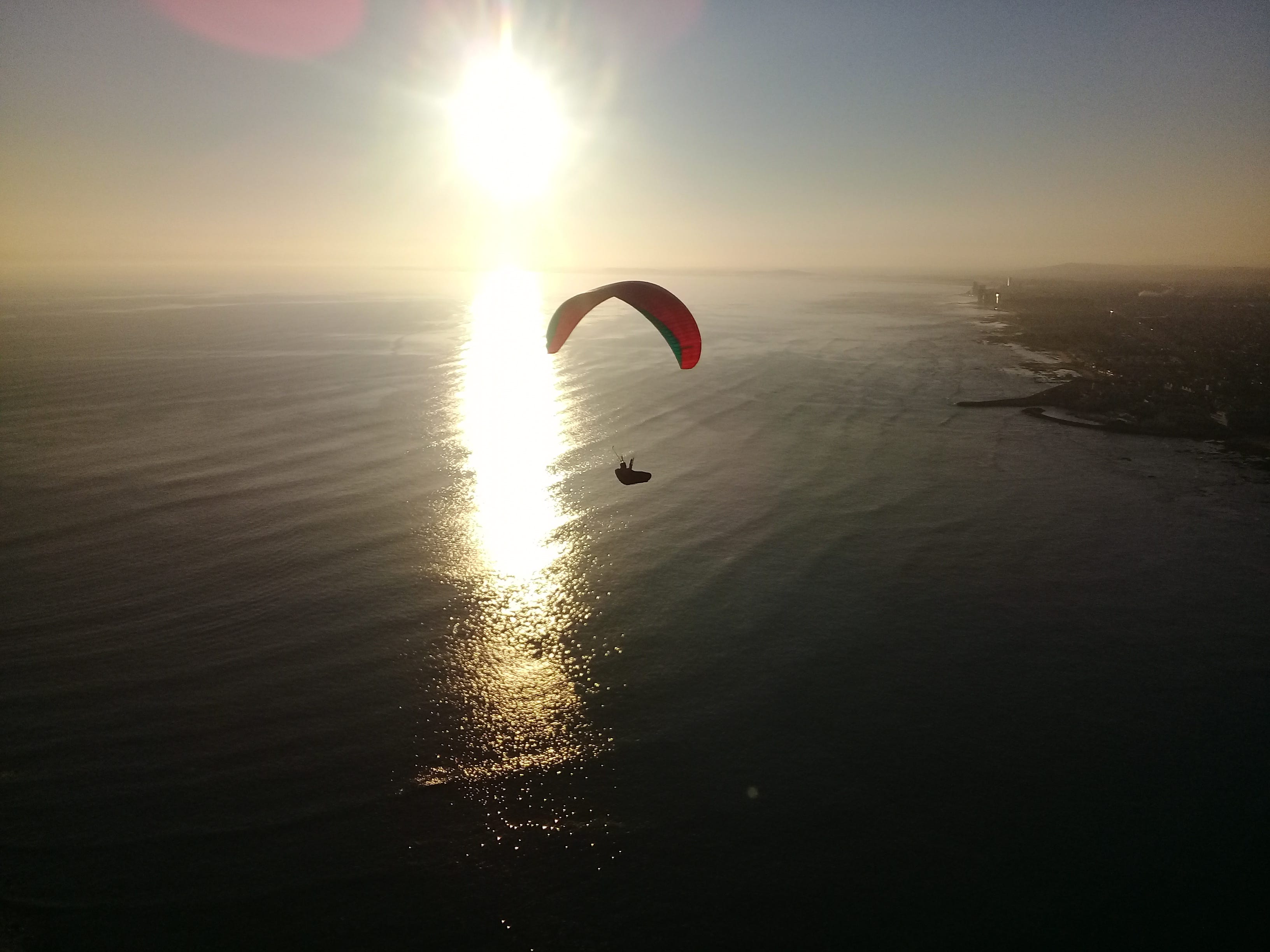
"The moment you doubt whether you can fly, you cease forever to be able to do it." -- J.M. Barrie
“Sh*t I’ve made a mistake” I said to myself.
I’d left a climb too early thinking I’d easily make it over into the next valley.
Below me, the rocky terrain baked in 40 degree Celsius heat becoming less inviting the lower I got. Hours away from a road. No phone reception.
The wind had picked up, bending the now broken and scrappy thermals towards the horizon.
I placed my hopes on a small rocky outcrop, flew over it, felt a surge of lift, tried to turn and it was gone.
More sink.
I looked down and imagined landing on the uninviting terrain below. I started to think about the what-ifs.
A sudden pulse of fear surged through my body.
I used to run away from this feeling. But after diving deep into flow science I now know that it’s there to help me. I now use it as a trigger.
Pulling my mind away from the what-ifs I looked up at the horizon, softened my gaze, and breathed deeply into the fear allowing its energy to fill my being.
I brought my attention to the feeling of my brakes and harness.
“You’ve got this Grant.”
I looked up.
A pair of black eagles, wings tucked, silent and majestic, passed above me, straight into the wind where I’d just come from.
Everything became crystal clear. What I can only describe as a knowing washed over me.
They’ve just left a thermal.
“Follow the line they’ve just come from” the Voice instructed me.
Without hesitation, and with full trust, I flew downwind deeper into the terrain. A few moments later my vario started to beep.
Deep in flow, relaxed and fluid, my whole body and mind in lock-step with the feedback I was getting from my glider and harness, I dissolved into the weak, scrappy and blown apart thermal, and became one with it for just long enough to climb and drift over the worst part of the terrain where I connected with a stronger climb and got back up to base.
People new to flow state often mistakenly think it’s reserved for the elite. But in reality flow is a fundamental human state shared across cultures and time that can be cultivated.
The paradox is that you can’t force or fight your way into flow. You can only provide the conditions needed to invite it into your life and strip away the forces that prevent it.
One of which is thinking.
Shoes off, sitting on my couch.
Cat on my shoulder licking my head.
Wind howling outside under the blue winter skies.
Let’s Go.
Think Less, Be More
Thinking is the crown jewel of human evolution.
It’s because of thinking that you’ve escaped nature’s hardships and live such a comfortable life.
Thinking lets you simulate future scenarios and solve complex problems.
It helps control raw impulses that you would otherwise be a slave to.
But when it comes to real-time high-stakes decision making relying on it can be fatal.
The neuroscientist Arne Dietrich, whose work underpins much of what follows, uses an example I keep coming back to.
Imagine the lightning-fast escape maneuvers of a squirrel. Without a strategy or plan, the squirrel gets to safety by relying on moment to moment adjustments.
Such smooth feedback-driven performance produces extremely complex movement that serves a higher goal (safety), but requires nothing more than the on-the-fly reactions to preceding input.
Thinking, while powerful, is slow and inefficient.
The explicit system, what I like to call the Egoself - responsible for higher order processing and self-reflective consciousness - can only hold about four items in mind at a time.
It’s not going to end well for our squirrel if it stops to calculate an escape plan before acting.
In fact, the number of possible next moves is so astronomically high that future projections would quickly branch to infinity. Such a nonlinear system is unpredictable, and thus future scenario planning is useless.
Instead, it uses the non-verbal intelligence that governs moment-to-moment movement known as the implicit system - or what I like to call, the Somaself. This is the automatic skill or experience-based intelligence held in the subconscious mind and the body.
Its content is not verbalizable, inaccessible to conscious awareness, and can only be conveyed through performance.
The explicit system is rule based and limited in its processing capacity. The implicit is intuitive and essentially unlimited.
Consider, for example, what it would take to write a computer programme that specifies each muscle twitch in the correct order and intensity to cobra-launch your glider. The computational difficulty of complex motion is enormous, a fact that is readily recognized by the robotics community.
The amount of information the working memory must hold far surpasses the capacity limit.
A complex motion such as launching your glider is either learned by observation or, if learned through explicit instruction, by breaking it up into smaller components, each of which cannot contain more than 4 independent pieces of information.
Once these are morphed into a single chunk, larger chunks can be combined to acquire intricate motion. Skill is built through practice when these chunks become internalised as patterns and the movement becomes automatic - also known as “muscle memory.”
The Somaself gifts us efficiency, fluidity of movement, and the wisdom of intuition. It allows us to be more.
All of which get dismantled when the conscious monitoring of the Egoself gets in the way.
Explicit rule based learning does work, but when the heat is on you will naturally revert to them. Consciously trying to force a skill that’s become automatic is why you buckle under the pressure when someone is watching.

Happy Landings
A Centipede was happy - quite! Until a Toad in fun Said ‘Pray, which leg comes after which?’ This raised her mind to such a pitch, She lay distracted in a ditch Thinking how to run.
The centipede’s dilemma — Katherine Craster, Pinafore Poems, 1871
Explicit attention to an automated (implicit) skill destroys it.
This is known as hyperreflection or Humphrey’s Law. Once a task is automatized, conscious thought about it while performing impairs performance.
In the words of baseball player Yogi Berra:
“You can’t think and hit at the same time.”
Think about what it takes to land a paraglider.
Starting with an idea of your landing spot, you progressively approximate the location by adjusting your movements based on updates of your trajectory and speed as you approach it.
Because it’s a dynamic situation happening in real time it requires efficiency and the fluid, moment-to-moment, effortless coordination of mind and body.
The explicit system is still active, it steers you towards your goal (the landing), but the doing must be handed over to implicit action.
If you try to take control by overthinking the landing or any other situation (like not wanting to bomb out) you inadvertently engage your explicit system and break the fluidity.
This is what happens when you try too hard.
Your mind wanders into the future. Anxiety and self-focus (how you look to others) kick in. Your mind goes into “control-mode” and starts to micromanage every move that should be automatic.
Instead of trusting your Somaself to perform, you force your consciousness into the machine and pull all the switches that were otherwise working perfectly well.
This is why watching crash videos is so problematic.
You’re trying to control an unpredictable future scenario with infinite possibilities using the wrong system for the job - also known as Analysis paralysis.
You try to remember the “right” sequence of steps which will vanish under pressure.
The Egoself grabs the steering wheel in doubt when you need to trust the Somaself to drive.
The tool for the job is not thinking it’s feeling.
Silence your ego. Surrender control to your Somaself. And your power will rise.
Easier said than done I hear you say.
Correct. But you’ve done it before.
Make it automatic
“Flying can’t be taught. But it can be learned.”
— Way of the Wing
You won’t remember it but when you learned to walk you took steps, a lot of steps, without the capacity for thought.
In a 2012 study it was shown that babies learning to walk, on average, take 2,367.6 steps per hour covering 701.2 metres and falling 17.4 times. Extrapolated over six hours that’s 14,000 steps and 100 falls a day.
For perspective, professional athletes and musicians need roughly four hours a day.
You learned the complex process of walking non-verbally through volume, variable movement, trial and error, and importantly play.
But there’s a catch.
Volume doesn’t always compound. Contrary to the popular saying practice doesn’t make perfect, practice makes permanent.
In other words what you practice sticks, including the bad habit of reaching for repeatable steps. This is why learning explicit rules like how many seconds to count in a thermal or what angle to bank at are so problematic.
They ask the Egoself to remember rules and explicitly apply them in an infinitely variable environment.
If you aren’t able to hand over conscious control to the Somaself you will find yourself stuck in overthinking, muscles tense, trying to fly.
You probably don’t have four hours a day to practice paragliding.
This is where coaching becomes so valuable.
A good coach won’t give you technical rules to follow but will instead bring your attention to what the lift feels like, for example, speeding up the time it takes you to discover, implicitly, how to thermal fly.
Try this: when thermalling instead of trying to remember how long to wait before you turn, imagine you’re accelerating upwards on a rollercoaster. Notice where and how strong the forces are. At the peak, just as it starts to slow down and the forces you feel start to back off, as the rollercoaster goes over the rise for the descent, make your turn.
This is learning by analogy, a well studied implicit learning approach that focusses on feeling over explicit technical instruction. Analogy learners hold up under pressure where rule based learners choke precisely for the reasons I’ve shared with you so far in this essay.
It’s changed the way I teach and how my students fly.
But even with good mental models and earned implicit skill you will underperform if interference creeps in, often leading to a doubt-induced fear state.
Flow helps us fly better by thinking less
When doubt gave way to trust on my flight with the eagles I dropped into flow and was gifted the beautiful experience of intuitive, thoughtfree action.
Flow is not as elusive as you might think.
In fact, it’s available to you daily and the more you can recognise it in everyday life and practice it on the ground the more it will show up in your flying.
As the most powerful and rewarding state known to humankind, its gift of intuitive and effortless efficiency is critical for us during high stakes flying moments.
In flow the explicit system (along with worrying, self-monitoring, and time-tracking) gets downregulated.
Flow is what it feels like when the Egoself gives up dominance and the critical voice stops.
Action and awareness become one as your attention becomes hyperfocussed on the task at hand. Mind, body, glider, air, as one.
Because downregulating the explicit system isn’t under your control you can’t force flow to happen.
But you can remove whatever blocks it by directing your attention to create the conditions that make dropping into flow far more likely.
You do this by developing implicit skill and removing interference.
Getting into flow is simple, but not easy.
You can’t think your way to skill. None of the “talented” pilots you admire came out the womb flying paragliders.
You practise your way there, then get out of the way.
Confidence comes from evidence. And with evidence comes trust.
With earned trust it becomes easier to let go and let the body take control.
Flow isn’t a passive state however. While it can feel almost automatic and effortless, you remain highly focussed. Letting your mind drift and wander isn’t flow - it’s daydreaming.
In fact, the first step to this practice is to notice when your mind goes adrift.
Imagine you’re getting low on an XC day.
“No, no, no, I don’t want to land,” you think to yourself.
Your abs tense up as you lean forward in your harness and look down at the ground. Your heart rate goes up. You become tight, rigid, and defensive, unable to feel subtle cues of lift. Self-focus increases as you think about what others might say or think. Frustrated and disappointed, your focus is so intent on the landing that your mind now guides you to the inevitable.
The mind doesn’t visualise the negative. If you close your eyes and say to yourself “don’t land” the only thing your mind can picture is the active verb - landing. If you say to yourself “I don’t want to have a collapse” what are you giving your mind to see?
Let’s break the spell so you have a fighting chance of that low save.
Note: While the framework is presented in sequence, trying to remember them as steps will only reactivate the explicit system. The principles need to be practiced, absorbed, and internalised so it becomes an automatic singular response.
Focus
Bring your attention to the here and now. Get out of your head and into your body. Notice any tension in your body. Feel the pressure in your brakes and the subtle shifts of pressure through your harness.
Centre
Breathe in through your nose from the belly with your tongue gently on the roof of your mouth. Breathe deeply into any negative emotions you are experiencing (such as Egofear) and let the energy fill your body. Find your centre in the eye of the storm.
Let Go
Sit back in your harness. Soften your gaze as if looking through a third eye. Smile. Let go of the need to control and accept whatever comes next. Invite the challenge. Tell yourself, “you got this” as you exhale and let go of any tension you might be feeling. Follow the feeling and let your intuition fly. You can only do this on a skill you’ve actually trained.
Don’t be mistaken, this isn’t a passive state. You’re not closing your eyes and hoping for the best. You’re simply removing interference and getting out of your own way.
When you release the worry about losing control a strange thing happens, you get the overwhelming sense of being more in control. In flow science this is known as the paradox of control.
This isn’t a guarantee that you’ll make that low save or nail that top landing, but it will put you in a more positive headspace and give you a fighting chance.
Make this practice part of daily life and the rewards gained as you master your inner self will far outweigh any external outcomes (that are out of your control anyway).
By adopting a flow mindset, each flight becomes a learning opportunity and an experiment. You don’t go out to fly 100km but instead go out to learn, grow and see what the day brings.
Developing a practice
In paragliding doubt = danger.
You can’t fool yourself. If you haven’t put in the reps you can’t just let go and trust your body to do something it’s never trained for. Trust must be earned.
You do this by putting hours in on the ground and in the air.
But it doesn’t stop there.
Mastering your mind starts at home. With your daily routines. Your habits. The things you do when no one is watching.
I’ve written a full free guide for you to develop your own flow practice here:

Only by applying these principles daily will they get embedded by the Somaself and available when you need them most. Only once you’ve racked up enough evidence through practise can you truly replace doubt with trust, think less, fly better and drop into flow.
“The moment you doubt whether you can fly, you cease forever to be able to do it.” -- J.M. Barrie
p.s. I’ve put together a free guide to building your own low stakes flow practice: six criteria for choosing one, the practice I settled on and why I recommend it, and the focus, centre, let go framework with a drill for each. Read it here.
p.p.s. Wingmates, where we work on these things together, is now reopened with a 7 day free trial. The coupon thinkless is available for the next 72 hours and gets you 10% off for as long as you’re a member. My thanks for reading this far.