

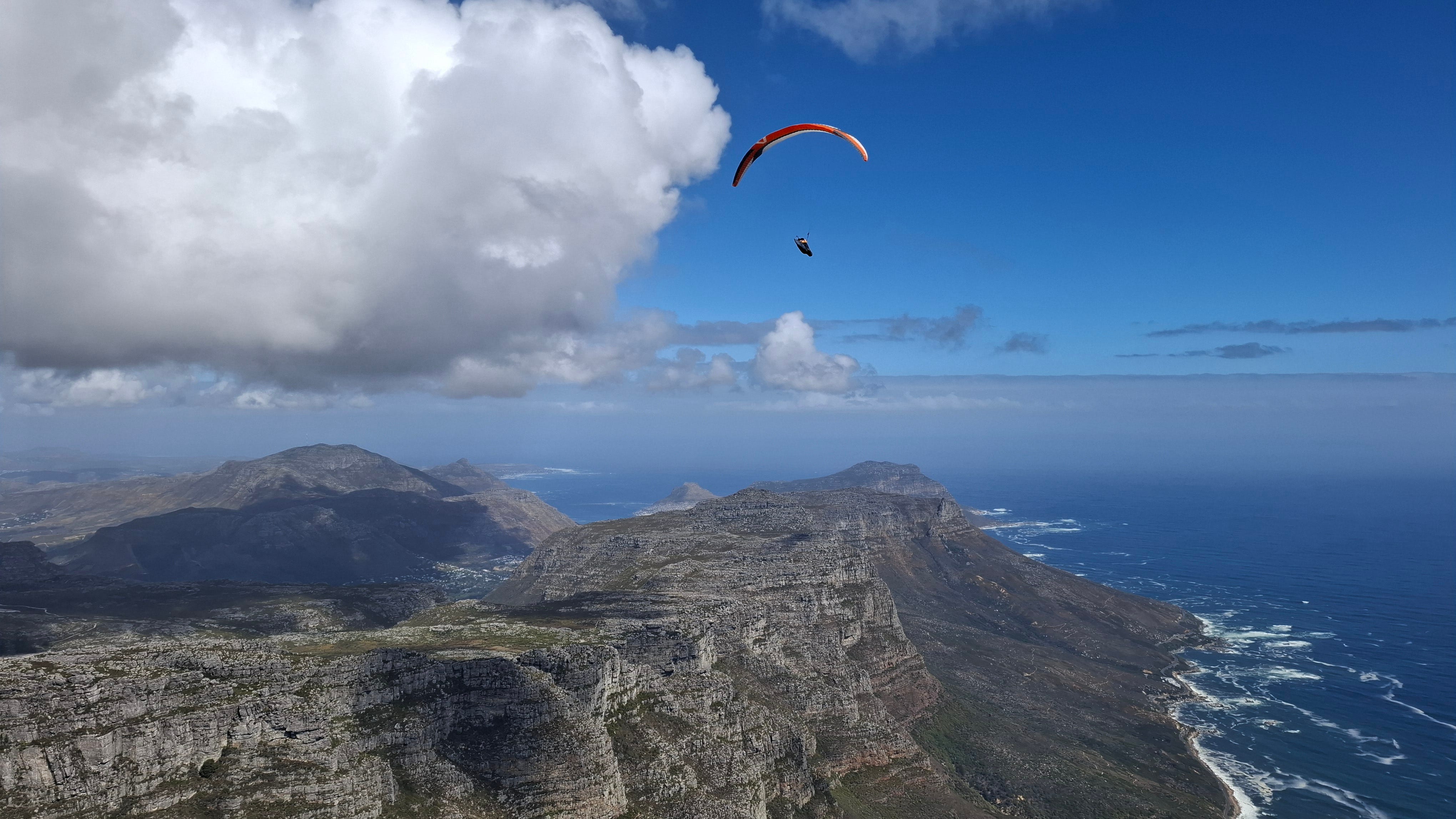
Paragliding is the pinnacle of human freedom.
The best days are simple. Just you, the sky, and your decisions. Each flight is an inner and outer journey, and when you’re in flow you land 50km, 100km, 200km — the number doesn’t matter — having grown, feeling like your true self.
But it doesn’t always stay that way.
A Way of Flow reader wrote:
Flying became too much of an obsession and had stopped giving me what I wanted from it — peace, fun, adventure, excitement, satisfaction.
How you fall out of love with paragliding
One of the most rewarding parts of my job as an Instructor, XC guide, and Flow Coach is witnessing freedom manifest when pilots have personal breakthroughs.
Recently a student bellowed out loud when he nailed a ground handling move. Six months ago a Wingmate broke through a fear barrier that almost made him quit. I see pilots finding confidence and changing their lives through their paragliding experiences. I see these deeply personal transformations all the time.
But I also see how this changes. How the lure of leagues, status, and metrics shifts the focus, causing pilots to lose some of that hard-won freedom. I experienced it myself, and if you’re still reading maybe you have too.
The most obvious symptom of this soulless drift is glider choice. Pilots take out ego insurance — buying gear they’re not ready for — as a shortcut around the harder work of skill and self-knowledge.
Chrigel Maurer put it plainly in an interview with XC Mag:
You have to keep your ego in check to avoid moving up a class. Some people would be better off with a lower category paraglider. They would have more fun, be safer and even fly further. But you have to be able to admit that to yourself. Are you enough of an adult to do that?
Carlo from Flybubble echoes this in this video where he says that gear choice is:
Often driven more by ego than actual readiness.
Why do pilots do this?
For the simple, largely unquestioned paragliding “truth.”
Performance is dead. Long live performance.
Performance. Performance. Performance.
No matter where you look this seems to be the underlying philosophy of our paragliding culture today.
Even the X-Alps — conceived as an adventure, a test of creativity and judgment — has become a race against the clock.
Most pilots think wing performance is their answer to flying further.
In 2025, 18-year-old Hugo Hadaš flew 498km on an EN-B — almost the same distance (512km) he’d flown on an EN-C the year before. The wing didn’t make the flight. He did.
The response is always the same — the conditions were perfect, the site is famous for it, he’s an experienced pilot. All true. But all beside the point.
Yes, gear expands the envelope — a faster wing opens days an EN-B can’t. But most pilots aren’t even close to their skill ceiling yet.
Many of these pilots have never flown 50km or even 100km before wanting to upgrade to the latest and greatest in the category, so that they can “fly further,” or to win, or to be the best — forgetting to ask if reaching these goals will make them happier.
But can you blame any of us?
The moment you qualify, you’re pointed toward your first competition. The content you consume celebrates numbers. The community asks “how far?” before it asks “how was it?” The heroes of the sport are defined by distance and speed. It’s a current — and it takes real self-awareness to swim against it.
Falling under the spell of both external metrics and gear, pilots unknowingly disempower themselves and make paragliding more dangerous by failing to recognise the most valuable tool they have in paragliding — their minds.
Passive safety is an illusion
It’s true, wings are safer these days.
But does that make you safer? Not according to Gerald Wilde. According to Wilde’s theory, people have a fixed internal tolerance for risk. Make something safer and they unconsciously compensate by taking more risk — until the felt danger matches your internal target again.
The classic example is seatbelts — mandatory seatbelts led to more reckless driving and more pedestrian deaths. Drivers felt safer, so they pushed harder.
Despite upgrades in passive safety, pilots don’t fly more conservatively — they push into conditions or manoeuvres they wouldn’t have touched before. Just look at the experienced pilots being killed on flare moustaches.
The gear doesn’t lower the risk. It just changes the set point. And you know what else changes it? Fame and glory.
Winning won’t make you happy
Most people believe that winning, to be the best and to make a name for themselves, equals happiness.
This is a tricky one to discuss because much of our society is built on it. It’s so pervasive that very few question it. Questioning competition touches a nerve that often leaves people triggered and defensive because they realise that they never sat down and decided this was the right way — they realise it was handed to them as a societal script and this lack of agency is scary.
But, like money, more doesn’t fill the soul.
In 2013 Ray Allen, one of the NBA’s all-time greatest three-point shooters, finally won the NBA championship — the moment he’d worked his whole career toward. He described the morning after as one of the most disorienting mornings of his life — he realised it hadn’t fulfilled him.
Ariel Zlatkovski set himself the goal to fly 100 x 100km flights in a year. He flew 800+ hours but the goal made him miserable. He found his joy again on a ridge soar in India, flying just for the sake of flying.
This is known as the arrival fallacy — we convince ourselves the next goal will finally do it. It never does.
The truth is that reaching goals isn’t the point. The richness comes from the journey and who we become along the way. Goals give direction and structure to a practice, but they’re meant to be in service of the process, not the point of it.
The goal points you toward the work; the work is where the meaning lives. As the famous Zen saying goes:
Do not mistake the finger pointing at the moon, for the moon itself.
At the heart of it all
What most of us fail to realise is that being extremely competitive and obsessed with performance often masks something deeper —
Still Nervous on Takeoff?

I first became obsessed with ground handling when I saw a video of Chrigel Maurer launching in an insane amount of wind at the 2014 X-Pyr. In this one short clip Chrigel shows us a skill-set, and the confidence to pull it off, that most pilots will never achieve.
— a fear of not being enough.
Fear of rejection, of failure, of not being loved or accepted. This fear moves underground and influences your decisions — you blame your wing for your performance, you make excuses, you narrow your safety margin for those extra few points on the scoreboard.
I don’t claim to be immune to these pulls myself. Much of what I’m writing here is with my past self in mind. The one lurking in the shadows that got sucked into the drama of ego and status games.
In a desperate attempt for recognition, egos get triggered and pilots jostle to show off and prove who knows the weather better, who is the best (whatever that even means), and you secretly wish pilots will bomb out on that record day that you missed out on so that they don’t get the points.
This, too, is hard to admit. But why else are you so obsessed with being recognised in your community? What does it matter what others think of your flying? When did paragliding become about the minds of others rather than the rich subjective experience that we miraculously get to experience?
But now, I feel like Ariel. I too rediscovered my joy — which I’ve come to realise is all about flow.
The X-Alps rookie Sebrand Warren discovered this too, having an immense battle with his ego and struggling with comparison for most of the event. That was until his girlfriend on a WhatsApp call told him to "try and have a little fun."
After that he dropped his expectations and his comparisons and had the flight of his life. As Gavin McClurg said to him at the finish line:
You found your flow.
From fear to freedom
Performance follows from process. Focus on the process — the daily practice, the craft, the showing up — and the outcomes will naturally follow. Reverse it (focus on the outcome) and you get the arrival fallacy: endless chasing, never truly arriving.
The same reader wrote back a few months later. Her flying was in a much better place — a couple of “whopping great big fun flights” before the season had really started. She'd got her confidence back. But she knew the trap was still there: "I just need to be super careful not to fall back into the obsessive numbers game. But from a great starting point instead of a frustrating one."
What will your flying focus be on next?
P.S. Wingmates is where we're doing this work together. Price goes up as soon as the Way of Fear course I'm working on is finished.
Thanks Grant, great article! Luckily I'm not a very competitive person. Nevertheless I sometimes feel the "danger" you are describing too and try hard to keep me off that track. Flow is the goal!
So, when do you know that you are ready to move up? Or how do you know that you should not consider moving up?
This post of yours hits hard. I am at the point of giving up, buying, yet another, high b or take the scary step of getting a low c…